


This week
Europe’s hacked freezers show the risk in Chinese robots at US labs
Why it matters: If your company or university lab owns a robot from Unitree, a Chinese maker, researchers have shown that outsiders can take control of it remotely. Nothing ties the freezer hacks to China. They show what that kind of takeover does to a machine that runs on its own.
What happened: Hackers got into supermarket freezers in five European countries and switched them to defrost or heated them to 50°C overnight. French stores were hit the same way in October. France’s cybersecurity agency says the hackers got in through control panels left online with weak passwords.
Unitree sells robot dogs and humanoids to many US universities and startups. Researchers found a flaw that let an outsider take over its robots through Bluetooth and pass the attack from robot to robot; Unitree says it has fixed most of it. Another security firm found that Unitree’s G1 humanoid sends activity data to servers in China every five minutes. The FCC’s July ban applies only to new foreign-made robots, so the ones already in US labs stay in use.
🎥 VIDEO: TBPN LIVE on X on Unitree robots, starting at 1:06. Good take from Will Manidis

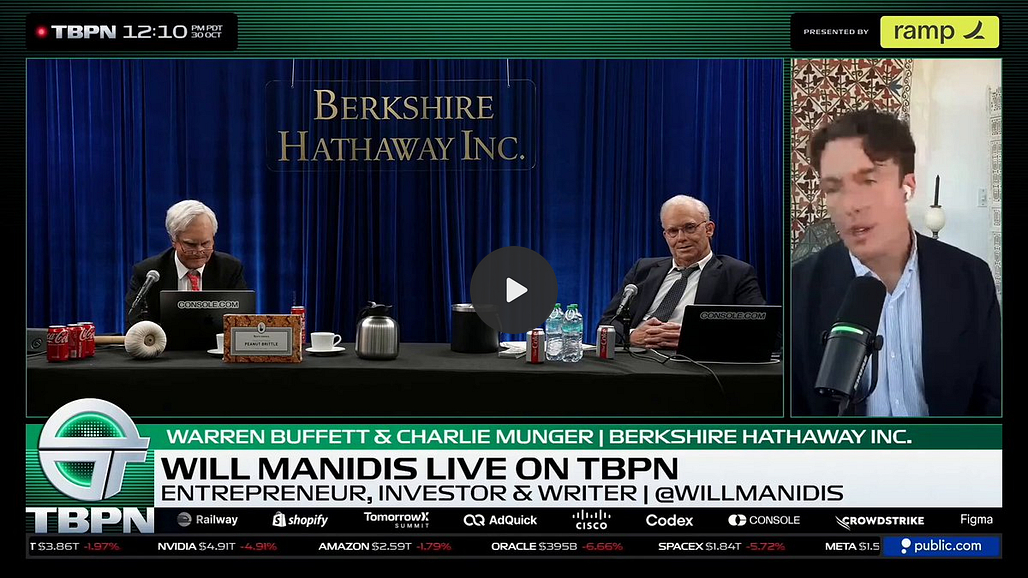
Calling the shot: A robot with cameras and microphones is worth more to a hacker than a freezer. The FCC ban covers robots that haven’t been sold yet. For robots already in labs, the owners will have to deal with the risks and consequences. Watch whether Washington acts on the robots already in use and puts new policies in place for sensitive industries.
Mbappé and Hello Kitty made the same mistake in China
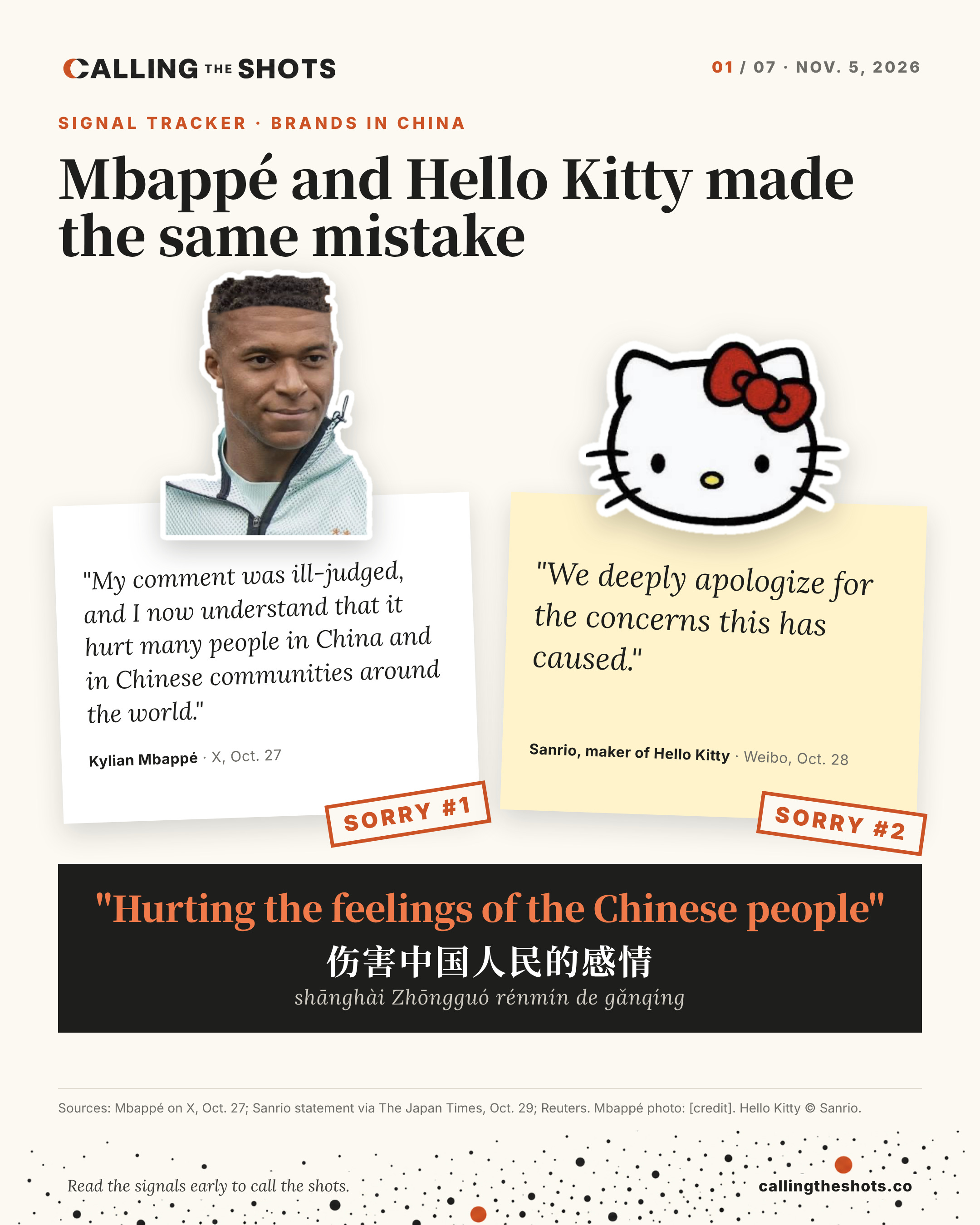
Why it matters: In 48 hours, a meme cost Mbappé his Chinese sponsors and a TV tie-in cost Hello Kitty a product line. Any US brand with a celebrity ambassador, a licensing deal or a content partnership in China can be hit by the same phrase, 伤害中国人民的感情 (shānghài Zhōngguó rénmín de gǎnqíng), “hurting the feelings of the Chinese people.”
What happened: Kylian Mbappé, France’s soccer captain, picked as his favorite meme one that put his face on Mao’s body, and called Mao “some guy, I think he’s a Chinese dictator.” Within a day, three Chinese sponsors dropped him and Chinese state TV stopped showing his league’s matches. He apologized in French, Chinese and English. Two days later, Sanrio, the Japanese company behind Hello Kitty, cancelled Hello Kitty toys dressed as characters from “VIVANT,” a Japanese spy drama in which Chinese agents torture a Japanese spy. Chinese state media had said the show smears China. Sanrio’s sales in China grew more than 40% in the first half of the year.
Why it hits home: Chinese schools teach the “century of humiliation,” the years from 1839 to 1945 when foreign powers defeated China and took parts of it, as a shared memory. A foreign insult lands as one more chapter of that story. The anger is also about respect. In the words of state-run Global Times, “one doesn’t get to profit from China while disrespecting it.” Many people reacted without ever seeing the remark, because state media refused to repeat it.
Calling the shot: Once the phrase is used, there is no debate left, only a fast apology that reaches people in China and abroad. Sanrio apologized only on Weibo and was asked to say it abroad too. Mbappé apologized in three languages and was still told “not accepted.” US brands escaped this one because Mbappé left Nike in September. Next time, brands are left holding whatever their ambassador has done, and it’s yet another reminder of where the red line is.
Beijing calls the midterms Trump’s report card, and keeps the summit on
Why it matters: Democrats won control of both the House and the Senate, and it’s an open question where the new majority lands on China, especially on data centers and the AI race.

What happened: China’s state news agency, Xinhua, called the vote Trump’s 期中考试 (qīzhōng kǎoshì), a “midterm exam,” under the headline “Democrats retake Congress; Trump’s governing under heavy pressure.” Officially, Beijing stayed calm. The foreign ministry called the election “a US internal affair” and said China will stick to what Xi Jinping and Donald Trump agreed. The two meet in about two weeks.
Calling the shot: Beijing is betting on its direct line to Trump. From January, Democrats will run the congressional committees that investigate companies’ China ties. US companies with China business will answer to a White House making deals and a Congress asking questions.
Nvidia reportedly limits how much its cloud partners can sell to Chinese companies
Why it matters: If your company sells or resells US chips or computing power, expect to be asked who your customers are. And if your CEO meets customers with China ties, this week showed how fast that can become a news story.
What happened: On Oct. 29, The New York Times reported that US intelligence had watched a Chinese executive at Megaspeed, a cloud company in Singapore, over suspected smuggling of Nvidia chips to China, and that she had grown close to Nvidia CEO Jensen Huang. Officials believed he did not know. Nvidia said the contacts were normal and that it had looked into the smuggling claims and dismissed them. Beijing called the report groundless. On Nov. 3, the Financial Times reported that Nvidia now requires its cloud partners to sell at least 51% of their services to non-Chinese companies on new contracts. Nvidia has not confirmed it.
Calling the shot: Nvidia answered a reputation problem with a contract rule. Cloud companies in Southeast Asia that buy its chips now have to track who their customers are, and Congress has a model to ask the same of other US chip and cloud companies.
The US bans imports from Chinese genomics giant BGI and its machine maker MGI
Why it matters: MGI makes BGI’s gene-sequencing machines, and US hospitals and research labs that run them can no longer count on importing parts and supplies.
What happened: On Oct. 29, the Department of Homeland Security put BGI and MGI on its forced-labor list, saying they helped with genetic testing in Xinjiang. Their products are now stopped at the US border unless importers prove they weren’t made with forced labor. Both companies deny it, and Beijing promised to respond. BGI makes less than 2% of its revenue in the Americas.
Calling the shot: US labs that bought MGI machines will see immediate impact. More Chinese biotech companies are likely to follow: the week before, the Treasury proposed limits on US investment in Chinese biotech. They need a plan and talking points lined up.
How Anthropic and OpenAI talk about China
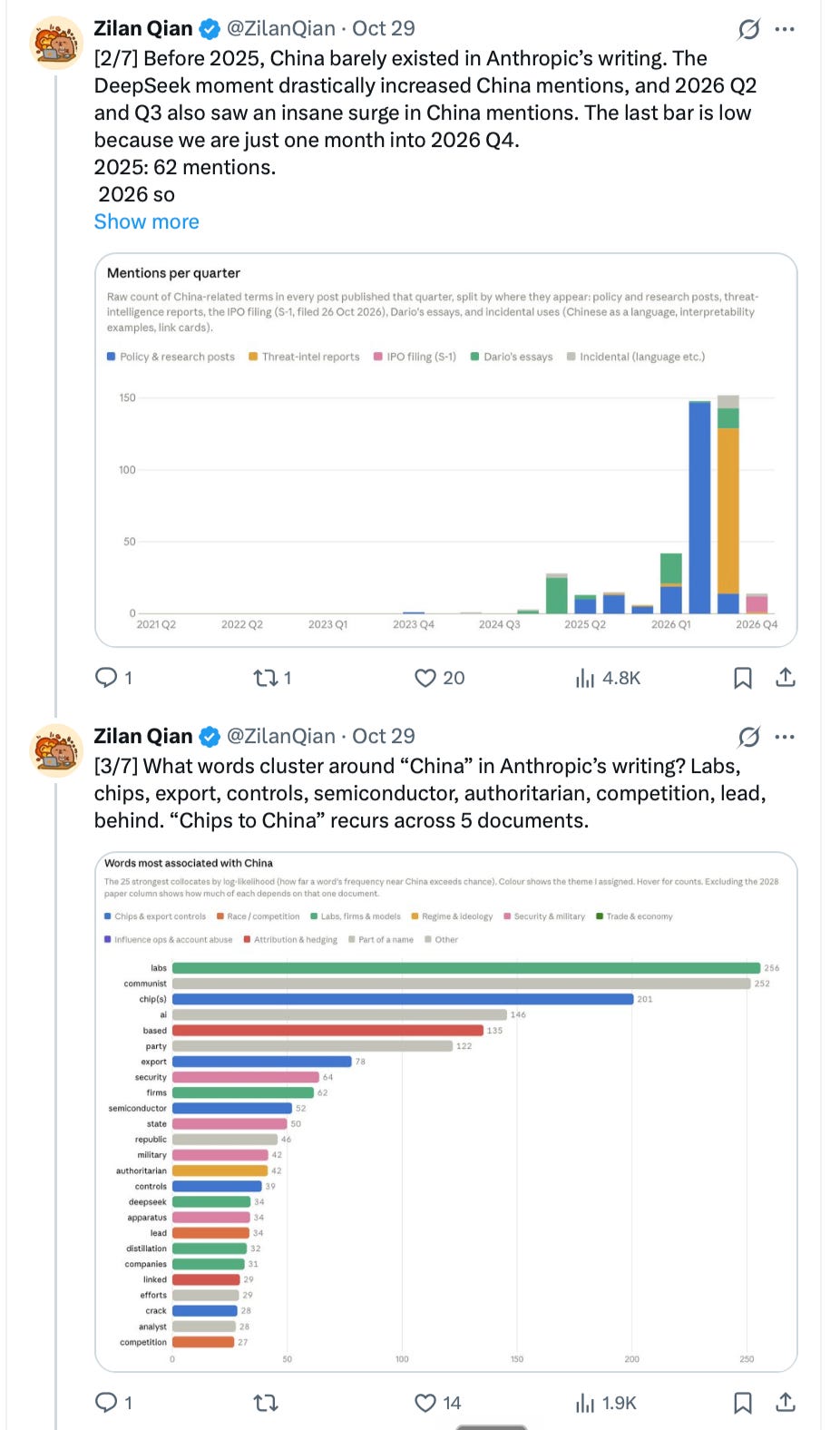
Why it matters: Zilan Qian compared how the two biggest US AI labs talk about China, and the findings are very different and extremely interesting.
What happened: Zilan went through what Anthropic, OpenAI, and their CEOs have published. Anthropic mostly talks about China as a rival in the race for chips and AI, and this year it calls China’s government “the CCP” far more often. OpenAI mostly mentions China in security reports about Chinese accounts it shut down for misuse.
Trust Moves
New this week: one company trying to earn trust in public, and it's my favorite company to write about, Temu.
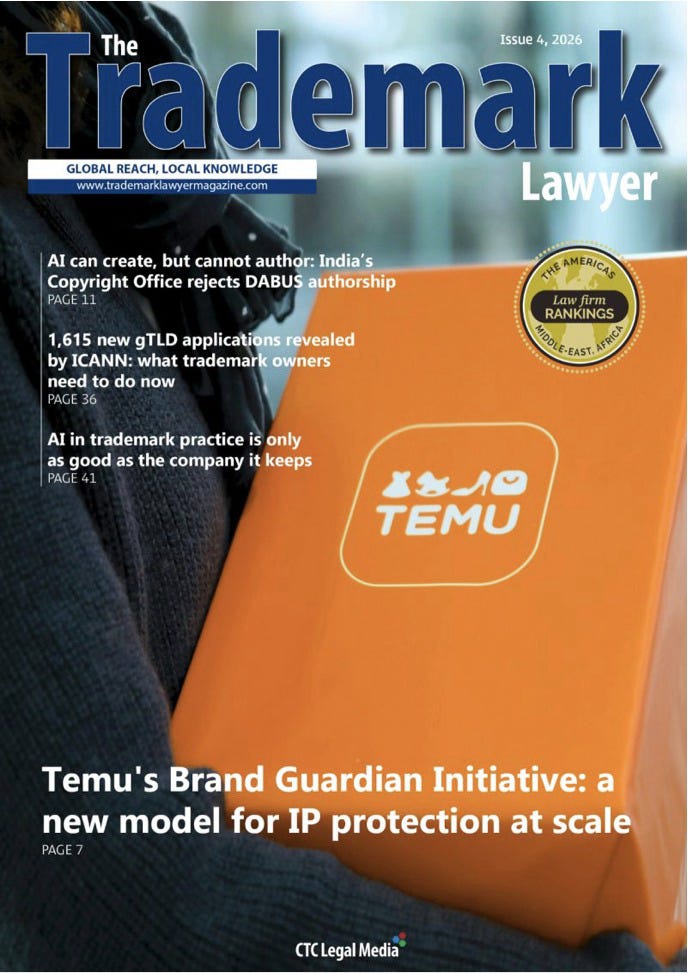
Temu wrote its own cover story for trademark lawyers
The Trademark Lawyer is a magazine for the lawyers who protect brands from fakes. Its latest cover story says Temu has fixed its fake-goods problem, and Temu wrote it: the author is Temu’s IP compliance manager, and the piece ends with Temu’s contact details. The magazine sells features that companies write about themselves, and this one fits that format. Temu’s evidence is a US brand: Rather Outdoors, a South Carolina fishing-gear maker, says it can no longer find fakes of its products on Temu. Separately, Temu agreed Oct. 16 to pay Texas $3 million and keep Texans’ data on US servers.
Calling the shot: Temu is pitching itself straight to the lawyers who used to file complaints against it, with a US brand as its reference. Watch whether readers can tell a paid feature from reporting, and if other brands back Temu’s claim. If you are a brand currently selling on Temu, or thinking about it, do you buy this narrative?