


The CTS Signal Tracker is a weekly read on the China stories that hit US business, so lawyers and communicators can tell their stakeholders what it means for them.
This week
Chinese AI labs are recruiting in San Francisco, and they first have to fix a reputation problem.
Microsoft is lobbying to keep buying a Chinese data center part that Washington wants to ban.
The Pentagon took Chinese drug lab WuXi AppTec off its military list, after a court ordered it.
1. Nvidia’s board investigates Jensen Huang
Why it matters: The CEO who spent three years arguing that Washington should let Nvidia sell to China is now under investigation by his board. Any US company that lobbies for China access will have to be careful with words.
What happened: Nvidia’s board said Nov. 8 it opened an independent investigation after reports that Huang was the target of a foreign intelligence effort. Huang acknowledged extramarital affairs with Alice Huang, a senior executive at Megaspeed, a Singapore data center company spun off from a Chinese gaming company in 2023. Huang continues to lead the company. The Republican chairs of the House China, Foreign Affairs and Intelligence committees have asked Huang for a closed-door briefing on Nov. 18.
Against this backdrop, Beijing is blocking 600,000 Nvidia H200 chips that Washington cleared.
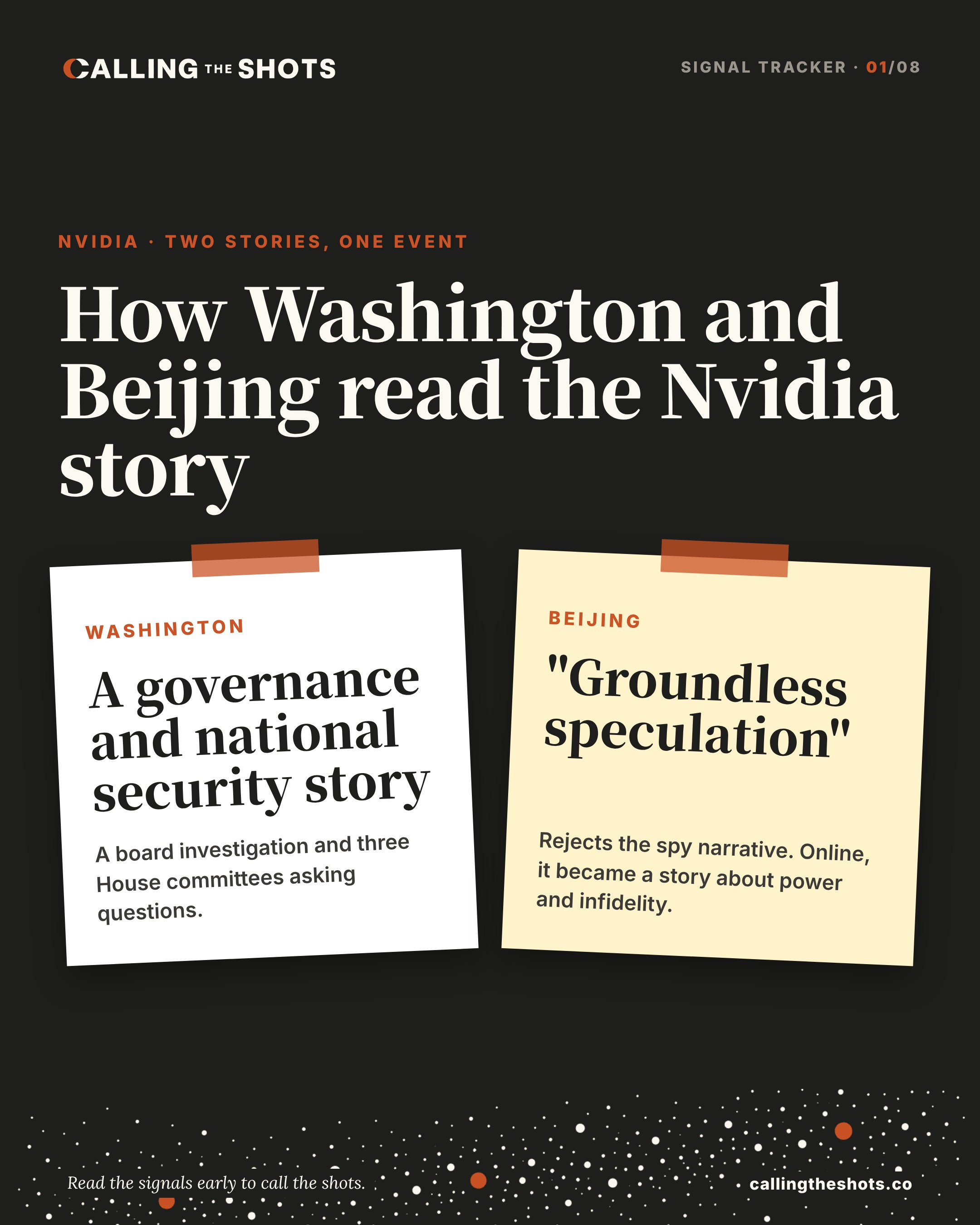
In the US, this is a governance and national security story: a board investigation, three House committees and an incoming Senate chair asking whether the man selling America’s most valuable chips was compromised. In Beijing, it is a smear, and the public discourse online has morphed into discussion about power and infidelity; China rejects the spy narrative and calls it “groundless speculation” aimed at smearing China.
Calling the shot: Nvidia is squeezed from both ends, and the story has taken on a life of its own, judging by the meme multiverse and some misogynistic and racially charged narratives that have come out. The case for selling chips to China just lost its best salesman as a Democratic Congress arrives, so expect chip limits in the defense bill. Who should buckle up: Nvidia’s cloud partners in Asia (Oracle, CoreWeave and the regional clouds renting to Chinese customers), server makers (Super Micro and Dell, see # 5), AMD, which makes the same case for China sales without Nvidia’s cover, any US company whose CEO lobbies for China access, and the data center hubs in Singapore and Malaysia now named in Washington as the route chips take to China. Every one of them will be asked who they do business with in Asia before Nvidia’s board finishes its work.
2. Chinese AI labs are recruiting in San Francisco, and they have a reputation to fix first
Why it matters: The AI Talent war is real, and other than perceived future payout and access, what are nonmonetary carrots to dangle in front of engineers? Chinese labs are now hiring in Silicon Valley, and they will compete with deep-pocketed players like OpenAI and Anthropic. It’s a sellers’ market, and good talent has outsized negotiation power.
What happened: Rest of World reported that MiniMax lists about 16 San Francisco roles, including a research lead for its core model, and that Moonshot AI, the lab behind the Kimi chatbot, is hiring US solutions architects.
In this clip, it sums up perfectly what working for Chinese companies is like: Chinese speed and intensity, and much higher expectations for output and results. Turnover is very high, and convincing global talent to join is hard.
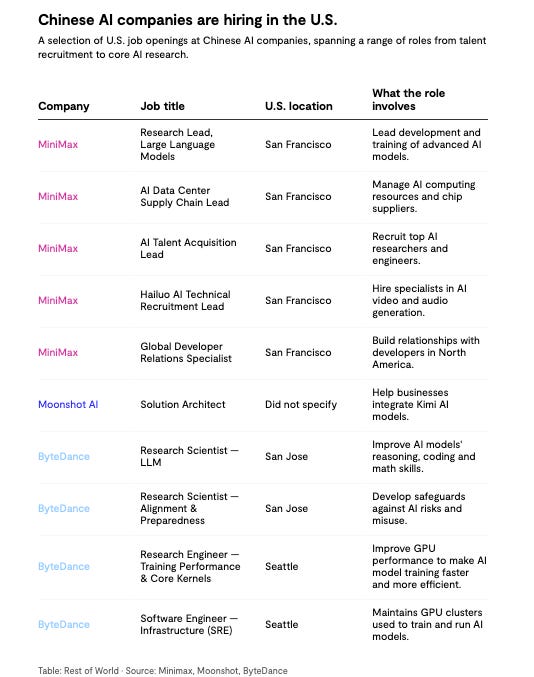
Calling the shot: Labs cannot recruit in San Francisco on salary alone. The Chinese labs now need employer branding: communication that positions them as a good place to work. That is a new comms job for Chinese AI companies, figuring out how to attract talent, navigating the scrutiny of who leaves from the big US labs, and engaging with lawmakers asking how chips reach China is likely to ask about people next.
3. Oracle walks away from a $7 billion chip lease with Tencent
Why it matters: Renting AI chips across data centers in Southeast Asia was the legal route for Chinese firms to access US hardware. Chinese tech giants and frontier AI labs need the resources for training models.
What happened: Oracle scrapped a chip leasing deal with Tencent worth an estimated $7 billion after the Trump administration leaned on it, the Financial Times reported. The five-year lease would have let Tencent use about 100,000 advanced AI chips in Oracle’s Southeast Asia data centers, chips it cannot buy at home. ByteDance and Alibaba still have large chip leasing deals with US providers.
Calling the shot: Tencent’s infrastructure spend has soared as it tries to close the gap with Alibaba’s Qwen model, and now it is at a disadvantage. It will also impact Oracle’s bottom line. US companies have faced pressure to cut exposure to Chinese customers, but many have done it only in rhetoric, not in practice. Managing shareholder/stakeholder expectations in this new reality will be paramount.
4. The top American open AI model is still waiting on its safety test
Why it matters: US companies already build products on Chinese open models because the cheap-and-good-enough ones are Chinese. An American alternative may change that choice.
What happened: Thinking Machines Lab, founded by former OpenAI technology chief Mira Murati, introduced Inkling 2 Small. The full weights will be released after external safety testing; it could be the highest-scoring open model built outside China. US companies are not waiting: hedge fund Bridgewater Associates used Tinker to build a custom version of Alibaba’s Qwen.
Calling the shot: Whether these weights ship decides whether US enterprise buyers get a serious open model that is not Chinese. Until they do, the default for cost-conscious US teams stays Qwen, DeepSeek, and Kimi. Cheap-and-good-enough seems to be the direction of model development, and that leaves food for thought for many startups that must choose this route or be exceptional to justify the cost.
5. Moonshot’s banned Nvidia chips came inside Super Micro servers
Why it matters: US rules keep Nvidia’s most advanced chips out of China, and they are getting in anyway. When they do, the US company named on the paperwork is often Super Micro, not Nvidia.
What happened: Nvidia makes AI chips. Super Micro, based in San Jose, builds the servers those chips go into. Data centers buy the servers, not loose chips. Moonshot is the Chinese AI lab behind the Kimi chatbot.
Bloomberg reported that documents Moonshot filed with Chinese regulators show it rented 32 Super Micro servers in China for about $65 million. The servers hold Nvidia’s B300, a chip the US rules bar from sale to China. Moonshot disputes the documents.
In July, a White House official accused Moonshot of using banned Nvidia chips to build its latest model. In March, US prosecutors charged Super Micro co-founder with illegally shipping $2.5 billion worth of servers with Nvidia chips to buyers in China.
Calling the shot: Nvidia is in the headlines, and Jensen Huang will have a rough road ahead, but the business of chips does not stop. Washington’s next step will likely target server makers, and Super Micro and Dell are the most exposed.
6. US-China: both countries’ trade weapons are paused until January
Why it matters: Washington and Beijing each have rules that make it harder for US companies to buy and sell. They’re on hold, with more uncertainty.
What happened:
The US rule. The US keeps a blacklist of foreign companies American firms can’t sell to without permission. A new rule would also cover any company that a blacklisted firm owns at least half of. US companies would have to check who owns their customers. The rule was due to start Nov. 10. Washington delayed it to January 10.
The China rule. China produces most of the world’s rare earths, the minerals inside the magnets in cars, phones and weapons. Last year it tightened its rules on selling them abroad, then paused the change as part of the trade truce. On Nov. 9, Beijing extended the pause to January 10. If the rules come back, even a factory outside China, say a US company’s plant in Mexico, could need Beijing’s permission to ship products made with Chinese rare earths.
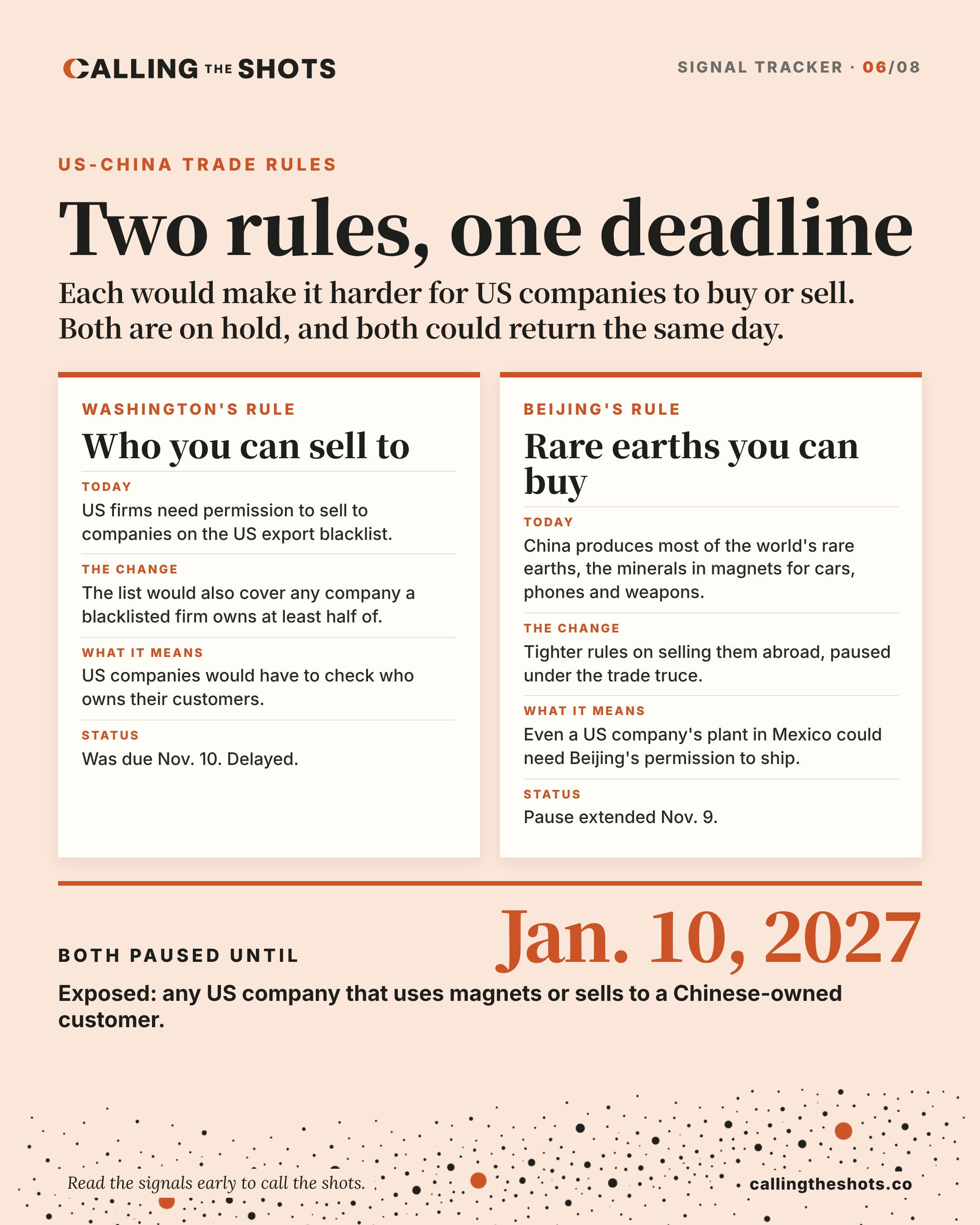
Calling the shot: The pause buys time, not certainty. Any US company that uses magnets or sells to a Chinese-owned customer is now planning around a date that could move again. Companies in limbo tend to go quiet, and their suppliers and customers read silence as having no plan. The ones that tell them now what they are checking, and what changes if the rules return, will look prepared either way.
7. Microsoft lobbies to keep buying a Chinese data center part
Why it matters: Washington wants to stop US data centers from buying a Chinese-made part, and one of the biggest US buyers is asking it not to.
What happened: The part is a small device that lets AI chips talk to each other over fiber-optic cables. It’s called an optical transceiver. A Chinese company, Innolight, sells more of them than anyone else.
The US telecom regulator, the FCC, has been writing a rule to stop US data centers from buying new Chinese models. It says Chinese parts could be used to steal data or shut systems down. On Nov. 10, Reuters reported, citing two unnamed sources, that Microsoft is asking the White House to drop the plan. The reason is supply: US makers can’t yet make enough of these parts to replace the Chinese ones.
Calling the shot: Microsoft is asking to keep a Chinese supplier in the same week Congress is asking how Chinese firms got close to Nvidia. Every company building data centers should expect the question “where do your parts come from?” They need an answer they can say publicly, delivered by media-trained executives who convey trust and authority. That’s what Jensen Huang did very well, and that spot will be MIA in the foreseeable future.
8. The Pentagon takes Chinese drug lab WuXi AppTec off its military list
Why it matters: WuXi AppTec helps develop and make medicines for many US drug companies. Its blacklisting put those partnerships at risk. Now the label is gone, for now.
What happened: WuXi AppTec is a Chinese company that US drug companies hire to do lab work and make drug ingredients.
The Pentagon keeps a list of companies it says help China’s military. Being on it bars a company from Pentagon contracts. It can also lead Congress to restrict US firms from working with the company, through a bill called the BIOSECURE Act.
WuXi sued to get off the list. A federal judge ordered the Pentagon to stop enforcing it, and on Nov. 9 the Pentagon removed WuXi.
Calling the shot: WuXi won in court, and the Pentagon’s view of WuXi hasn’t changed. US drug companies get breathing room. Other Chinese companies on the list now know they can sue too. The next fight is in Congress, which can name companies itself in the BIOSECURE Act. Here’s an op-ed I co-wrote with @jaxon Chen on the Biosecure Act where we argue the act threatens already strained US supply chain.
A trillion-dollar surplus means the world keeps buying from China.
This week, Washington decided, deal by deal, how it will wield that power to make it harder.
If this was useful, forward it to the person who handles the internal and stakeholder storytelling. And if you want to talk through what this week means for you, I’d love to chat; just reply to this email.
Thank you for reading.