From Crisis to WSJ Puff Piece: Arc’Teryx’s Luckiest Quarter Yet
Analysis of what’s missing from the WSJ story that resets the record in Arc’teryx’s favor
Arc’teryx PR deserves a raise.
In the recent WSJ Exchange front-page feature, “Arc’teryx Won Over China With a $1,000 Jacket. Now It’s Popping Up Everywhere,” the brand essentially gets a beautifully packaged replay of its own talking points:
China is the growth engine.
Arc’teryx can charge 20% more in China than in the U.S., even in a deflationary economy.
The Cai Guo-Qiang Tibetan Plateau outrage “hasn’t stopped its growth in China,” and “a widespread boycott didn’t materialize.”
Amer Sports’ stock is up 28% this year.
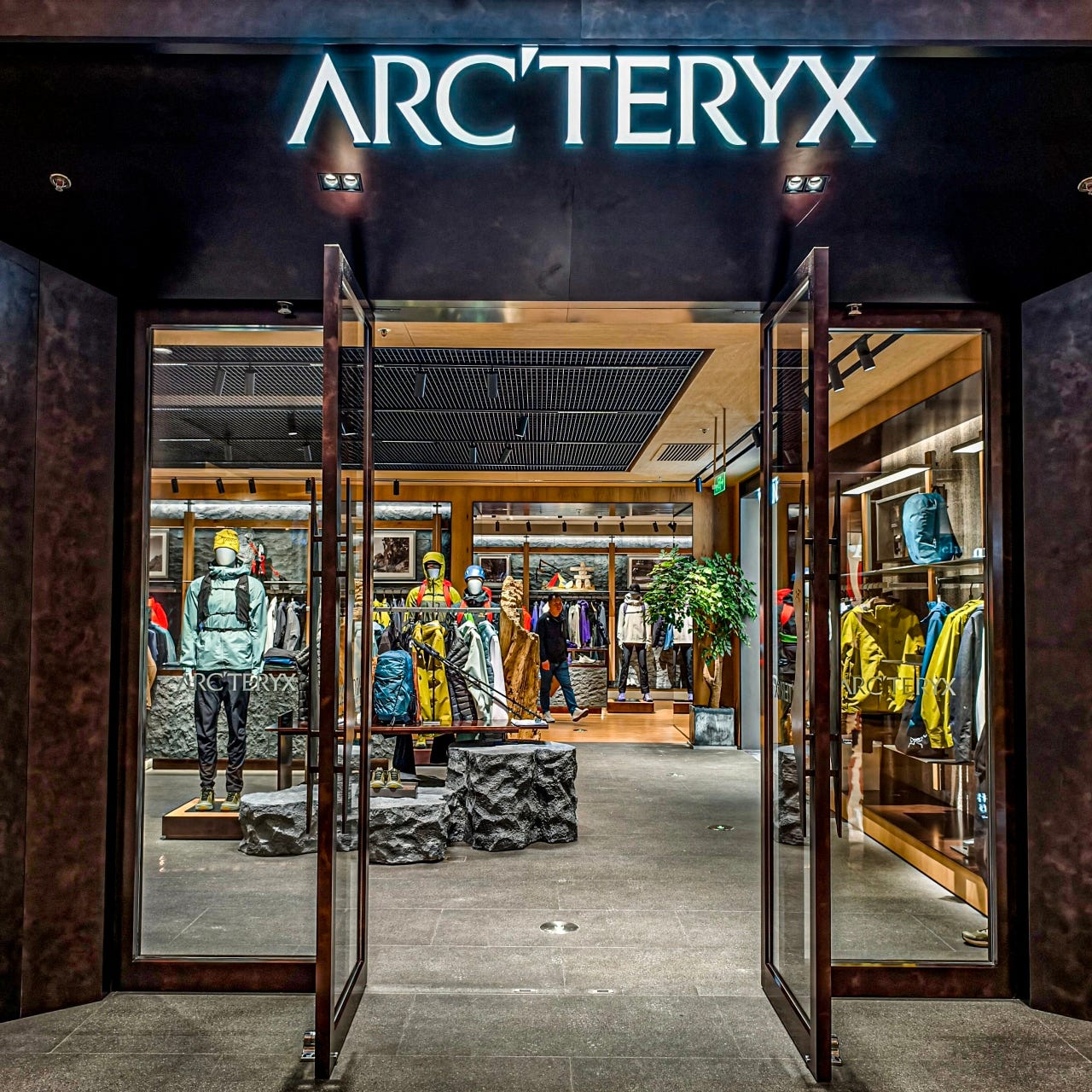
This is exactly the investor thesis from Amer, Arc’Teryx’s parent company: Greater China as the growth engine, Arc’Teryx as the hero asset, differentiated from luxury names like LVMH and Kering that are supposedly struggling to unlock Chinese demand. The WSJ piece doesn’t interrogate that story; it reaffirms it, at length, with some colorful anecdotes layered on top.
If you don’t follow the brand or the crisis closely, you walk away thinking: Arc’teryx is one of the rare brands winning in China while the Chanels and Guccis sputter; the Tibet thing blew over; management knows what it’s doing.
The piece misses the mark in a few areas:
Contradictions within the WSJ narrative itself
A very confident conclusion about Tibet and “no boycott” built on pre-crisis numbers
Missing ownership context, and what that implies for Arc’teryx’s future
A misleading portrayal of the Chinese consumer
“High value is the new high end” – on whose terms?
One of the article’s core claims is that Arc’teryx has nailed the mood of the Chinese consumer, and “high value is the new high end.”
At the same time, the piece gives you this line from Stuart Haselden, Arc’teryx’s CEO:
“We sit in between sport and luxury,” he said in an interview. “It’s helped us to do well as the consumer environment has been challenging in China.”
And right alongside that, WSJ tells you that:
Arc’teryx prices its products about 20% higher in China than in the U.S.
China delivers wider profit margins than other regions.
High value for whom? The Chinese consumer—or Amer’s gross margin line?
The implied picture—that logo-conscious Chinese consumers are now trading LVMH and Gucci for Arc’teryx as their new expression of “high end”—is a big stretch. More likely, a thin upper slice is simply adding Arc’teryx to an existing roster of aspirational logos, not graduating from luxury to a higher plane of performance virtue. Wealthy Chinese shoppers haven’t “pulled back” from flashy luxury at all; they are buying Arc’teryx for the logo, as most of the Chinese consumers cited in the piece make clear. And if those same consumers are paying roughly 20% more than Americans for the privilege, it’s hard to argue that “value” is accruing anywhere except on Amer’s margin line.
2. “Boycott didn’t materialize” – based on a mostly pre-crisis quarter
The strongest reassurance in the WSJ piece is this: Arc’teryx’s sponsorship of a Cai Guo-Qiang fireworks display on the Tibetan Plateau “hasn’t stopped its growth in China,” and “a widespread boycott didn’t materialize.”
Arc’teryx × Cai Guo-Qiang: One Crisis, Two PR Strategies
Much has been written about the Arc’teryx × Cai Guo-Qiang controversy. Zichen, Baiguan, and Yaling have strong analysis of the drama that’s unfolded over the weekend.
The first problem is simple: Q3, by definition, cannot fully reflect the aftermath of the Tibet event.
The WSJ piece leans on Amer’s Q3 results to argue the crisis passed with little impact on Amer’s earnings. To back that up, it notes that Amer reported Q3 results on November 18, with revenue up 30% to $1.76 billion and Greater China sales up 47% year over year. On the surface, that sounds like proof.
But the timing makes those numbers a poor test of the claim. The Cai Guo-Qiang × Arc’teryx fireworks event took place on September 19, followed by days of condemnation and calls for a boycott on Chinese social media. Amer Sports runs on a calendar fiscal year; Q3 2025 covers July 1 to September 30, 2025.
Those Q3 numbers are real—but they are overwhelmingly pre-crisis. Q3 tells you Arc’teryx was on fire in China before the event; it tells you almost nothing about the long-term consequences of the outrage that followed.
For the period where any real impact would show up—Q4—the article relies on a single piece of management guidance: Amer’s CEO acknowledges an “initial slowdown at the start of the fourth quarter,” but says sales growth has since rebounded “as the weather has cooled.”
A more balanced approach would have been:
Q3, mostly pre-Tibet, was very strong.
Management claims that Q4 is recovering after an initial dip.
It is too early to know what the longer-term effects on the brand, pricing, and community will be.
Instead, the piece moves quickly to close the loop: Tibet happened, there was outrage, an apology, a cancelled academy, some restoration payments, and then sales and stock bounced back. End of story.
What’s missing is any real curiosity about what Chinese online outrage actually does over time—how it can erode moral authority, push core outdoor users toward other brands, or leave a lingering sense that something about the Arc’teryx story no longer rings true, even if that doesn’t show up as an immediate collapse in quarterly revenue.
3. Who owns Arc’teryx, and what future is it optimizing for?
The article does at least name the key players behind Arc’teryx: Anta, Amer, and Lululemon.
What it doesn’t do is connect those dots to Arc’teryx’s risk appetite and long-term direction.
Public filings show that entities affiliated with Anta hold an effectively controlling stake in Amer, making Anta its dominant shareholder. Under that structure, Amer’s ties to China have deepened—operationally, commercially, and strategically—and the reasoning in the piece why Arc’teryx can still win in China while the LVMHs and Kerings of the world struggle.
The WSJ piece conveniently replays and refreshes this thesis for a broader readership.
But to tell a whole story about how Arc’teryx is a “conquering China” case study, you can’t stop at “Anta owns a big chunk.” You also have to ask:
How does Anta’s China-first priority shape the kinds of risks Arc’teryx takes—like a high-profile fireworks spectacle on the Tibetan Plateau for publicity?
When the aforementioned controversial stunt blows up, what guardrails, if any, does Amer put in place to make sure it never gets that far again?
How does the brand reconcile those pressures with the values Arc’Teryx claims—mountain respect, technical integrity, and environmental stewardship?
On that last question, the WSJ piece actually hints at another future: Amer wants North America to “catch up” to China in sales by 2030. That’s a big ambition. It raises some apparent tensions that the story doesn’t even poke at:
If the most significant growth so far has come from logo-loving, wealthier Chinese consumers paying a premium, and the brand's founding story is about hardcore outdoor athletes, what will Arc’Teryx’s product assortment and production system look like in 2030?
How will Arc’teryx prioritize R&D, store locations, and marketing when Anta-style volume growth in China and “salvaging the outdoor sporting community” in North America may not always pull in the same direction?
They aren’t theoretical governance questions; they go to the heart of what Arc’teryx becomes over the next decade. In such a long feature that positions itself as a look at Arc’teryx’s future, the absence of these types of questions is conspicuous.
4. The fantasy civil servant and teacher Arc’Teryx consumers that are so NOT the Chinese middle class
The most revealing part of the WSJ story is the closing anecdote.
We meet Zhao, a 28-year-old civil servant, and Lu, a 28-year-old teacher. Ahead of their first “outdoorsy” vacation to Iceland, they walk into an Arc’teryx store, and each buys an approximately $800 waterproof jacket. One reason they choose Arc’teryx: “everyone can recognize the logo.”
On the page, it’s a charming little scene. In the piece's structure, it does much heavier work: it serves as the image of the “new Chinese middle class” on which the China growth narrative rests.
Anyone with a realistic sense of what teachers and civil servants earn in China will recognize this as an exception rather than a representative snapshot of the middle class. Two $800 jackets plus an Iceland vacation is a major financial event even for many private-sector professionals.
What their story actually demonstrates is something much narrower: that a thin, relatively affluent slice of young Chinese can and will buy Arc’teryx as a status symbol, alongside other global luxury brands, when the brand’s story and social signals align.
But by presenting this couple as emblematic, the piece doesn’t just generalize about “Chinese consumers”; it elevates them into an aspirational fantasy that flatters Arc’teryx’s investor story. They become the emotional proof point that a 20% China premium is reasonable, twenty-somethings are spending thousands on jackets, and that investors can rejoice.
The missing step in all of this
If I put on my PR consultant hat for a second, I can almost see the sequence inside Amer and Anta. You watch the Tibet outrage run its course. You ride out the first wave of anger and boycott calls. You see that Q3 is still strong. By late autumn, you decide the worst is over, and it’s time to repair confidence. You line up a WSJ Exchange feature, put forward an eloquent CEO to talk China growth and global ambitions, acknowledge the controversy briefly, show contrition, and make sure two lines land clearly:
“A widespread boycott of Arc’teryx didn’t materialize.”
“The stock is up 28% this year.”
As a communications strategy, it’s solid. I’d advise a version of it myself.
What’s missing—and what the WSJ piece never really pushes for—is the step in between: a strong, specific commitment that foreshadows real change. Something closer to:
“As a mountaineer brand by DNA, we will protect the mountain and the brand at all cost. Here is how we will make sure a Tibet-style stunt never gets green-lit again.”
Instead, the closure is a short paragraph in passing: the academy was cancelled, a GM stepped down, and local authorities ordered restoration payments. There’s no real discussion of how decision-making has changed, what internal guardrails are now in place, or how Arc’teryx plans to rebuild trust with the outdoor and environmental communities it offended.
From a PR standpoint, timing a big WSJ Exchange hit to a strong Q3 and using it to underscore “no boycott” and “stock up 28%” is a textbook way to stabilize sentiment. No PR team gets punished for reassuring the market. But for a company that constantly invokes its “mountain DNA,” this was also a rare chance to say something concrete about values and the future—and that chance was mostly spent proving that Tibet didn’t dent the quarter.
That may be comforting for investors, but it is a narrower story than the brand is capable of telling. If Arc’teryx truly wants to sit “between sport and luxury” and still be taken seriously by climbers, hikers, and mountain towns, it has to show that a Tibetan Plateau fireworks stunt is more than a footnote that happened to leave Q3 intact. The brands that endure treat moments like this not as blips to wave away, but as chances to prove their DNA is something deeper than a logo and a line on an earnings slide.