


When Justice Department lawyer Taylor Stout opened Huawei’s trial in Brooklyn on September 9 with “theft, lies, cover-up,” he was going for the headlines. The current trial is a continuation of the original indictment that began in 2018, when the United States charged Huawei and its chief financial officer, Meng Wanzhou.
The prosecution alleges Huawei’s 20-year pattern: trade-secret theft, bank fraud, sanctions violations, concealment. Huawei has pleaded not guilty and its position, delivered by lead trial counsel Brian Heberlig, is that this is “competition, not conspiracy. Innovation, not theft,” and that prosecutors have cherry-picked isolated incidents and recast ordinary competition, plus misconduct by a handful of employees, as an institutional conspiracy. The trial is expected to run about three months, but the reputational battle will be longer and harder to salvage.
So how did Huawei get here? The Commerce Department put Huawei on the Entity List in May 2019, which limited its ability to do business by cutting it off from American chips and software. In 2020, prosecutors added racketeering charges and trade-secret allegations. For most of the past decade, in the U.S. and in Europe, Huawei has often been covered by the media with its name in the same sentence as espionage, sanctions, IP theft, and national security. The prosecution built its case with public opinion in mind.
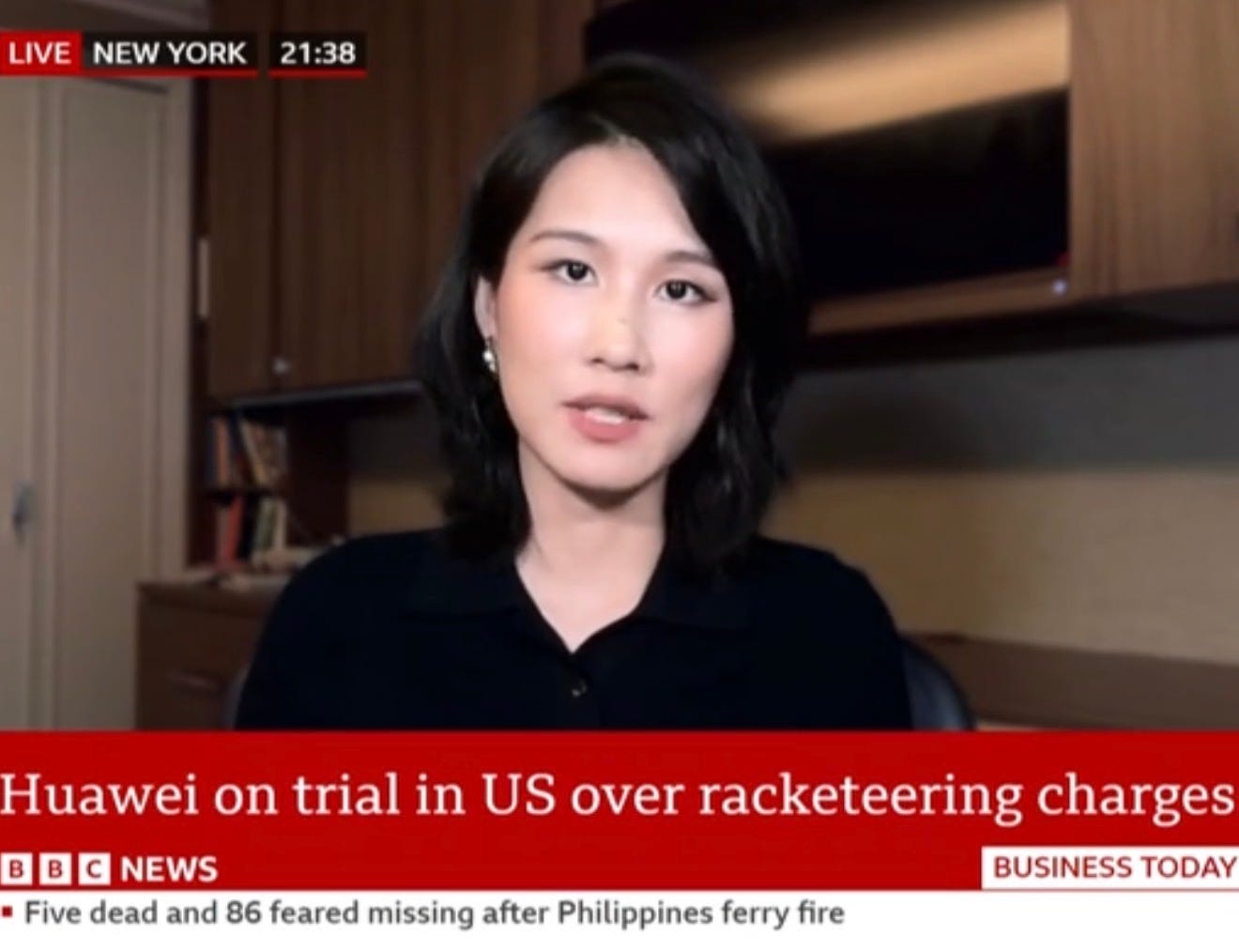
The alleged misconduct spans countries, business units, and decades, from Cisco source code, a T-Mobile phone-testing robot, equipment photographed at a Fujitsu trade show, the Skycom relationship in Iran, and more. Two weeks in, the jury has seen most of that list in person. As I said on the BBC recently, what’s on trial is Huawei’s institutional character. But we should be careful about extrapolating from Huawei and what this trial tells us about an entire category of Chinese companies. The evidence in this case is Huawei-specific. BUT this is not to say that Huawei hasn’t also become a proxy through which many Western governments learned to think about Chinese technology companies.
The timing is also not idea. President Xi Jinping arrives in Washington on September 23 for a state visit, the first by a Chinese president in over a decade, with chips, tariffs and AI on the agenda. For now, court proceedings continue. The Foreign Ministry’s line is that Beijing “firmly opposes the U.S. side’s suppression and containment of Chinese enterprises.” But will Washington use the trial as leverage in negotiations?
Huawei’s standing response is that Washington is trying to contain a successful Chinese competitor. The line has an audience too, and an important one for Huawei, and you can guess whom.
Huawei has more than one reputation and is a chameleon in many ways. In China, Huawei is the national champion that survived an American attempt to kill it. Across much of the emerging world, it is a capable vendor that ships on time and prices below Ericsson and Samsung. In Washington and much of Europe, it is the cautionary tale about letting a Chinese company into critical infrastructure. Its technological and institutional reputations have been moving in opposite directions for years. Huawei reported roughly $127.5 billion in revenue for 2025 and has built a serious AI-chip business under sanctions. Commercial survival reinforces Huawei's image as a formidable engineering juggernaut. It has done little to answer the Western questions about ownership, state influence and compliance, and the trial will not answer them either.
Huawei’s best chance of breaking the prosecution’s narrative pattern is to refuse the pattern and answer four questions separately:
1.what constitutes rogue employee behavior; 2. what Huawei’s management knew; 3. how the company responded; and 4. which of that conduct the government can prove was institutional strategy.
Huawei’s counsel Heberlig’s opening did this in one sentence, “there was no blueprint for crime,” and the company’s public communications have not done it since to expand on this very important distinction. The prosecution’s case depends on whether it can weave the evidence for all four into one coherent thesis. Huawei’s case depends on keeping them separate.
What Huawei should actually do for the next three months
Let the trial exist in Chinese. The instinct from Huawei’s China PR team will be to keep the coverage out of domestic Chinese-language channels, or to answer every Western headline with a rebuttal in Chinese write-ups. And it will be tempting to do both. But having no trace of a three-month federal trial tells readers it cannot handle the facts in its own language and country, and the silence will be read as fear. Huawei should let the factual record of the proceedings exist in Chinese, unadorned and reinterpreted to work in its favor. A neutral factual account is the posture of a company that expects to be judged on the evidence, which is what it is asking the jury to do.
Separate the legal strategy from the perception of the legal strategy. Huawei, as the defense, does not owe the public a play-by-play of its legal strategy. Right now the only visible narrative strategy is “Washington is out to get us,” which reads to a banker or a carrier as an admission that nothing in the indictment can be contested on the merits. The comms job is to make the defense look like it has a theory of the case, without saying what it is. That means someone outside the legal team, with a mandate from the top, decides every week what the outside world should understand about Huawei’s posture: contesting the institutional character framing, cooperating with the court, and being prepared to be examined. The lawyers will hate this (and so be it). Give them veto on facts, but not on posture.
Run the trial as a stakeholder campaign, with the public as one stakeholder among many. The audiences the trial actually moves are not in the U.S. They are the carriers in SEA, Africa, and the Gulf who currently work with Huawei and who will be asked by their own regulators and boards, sometime in the next three months, why they shouldn’t look for alternatives if Huawei loses. The Chinese government will also follow every step of the trial of its national technology champion. Each of these needs a briefing cadence, and a version of the facts that is shared and explained before the headlines do. Huawei’s country teams should be able to walk a client through a bad day of testimony the same afternoon, with a written note the customer can easily forward to their stakeholders. It is a different discipline from the public statement. One rule for every one of those notes: write it as if it will all be public information because some of them will be.
Plan for the verdict and for the eight years after it. The trial is planned for three months. The story will run longer, with trial facts resurfacing at different points in time.
The bigger implication will be the trickle-down effect of how Chinese tech companies will be evaluated going forward. This month, U.S. security agencies accused several Chinese AI companies of “industrial-scale” distillation of American models. The technical and legal issues have little to do with Huawei’s case, but the logic is not dissimilar: distillation is IP theft 2.0.
Huawei’s trial is a case study in how trust and distrust compound. A conviction could deepen its exclusion from Western finance, technology, and supply chains. The courtroom drama has already started, and the first witness set the register for everything that followed. Baheshti, an Iran-born naturalized U.S. citizen, told the jury he was infuriated that Huawei had helped Iran’s rulers deploy technology to block ordinary Iranians’ access to news and social networks.
“They helped a dictatorship to rule and suppress people,” Baheshti testified.