

It's Zeitgeist-Fluency
Cheap tokens, a frat house startup with a16z money, an Adidas viral meme in China. A lot on my mind before I get on a plane to China.

I’m heading back to China, and there will be lots to share from the ground. I’ll be in Wuhan, Shanghai, Beijing, Hong Kong, Mongolia, Seoul and more. Please say Hi if you are also in China this summer!
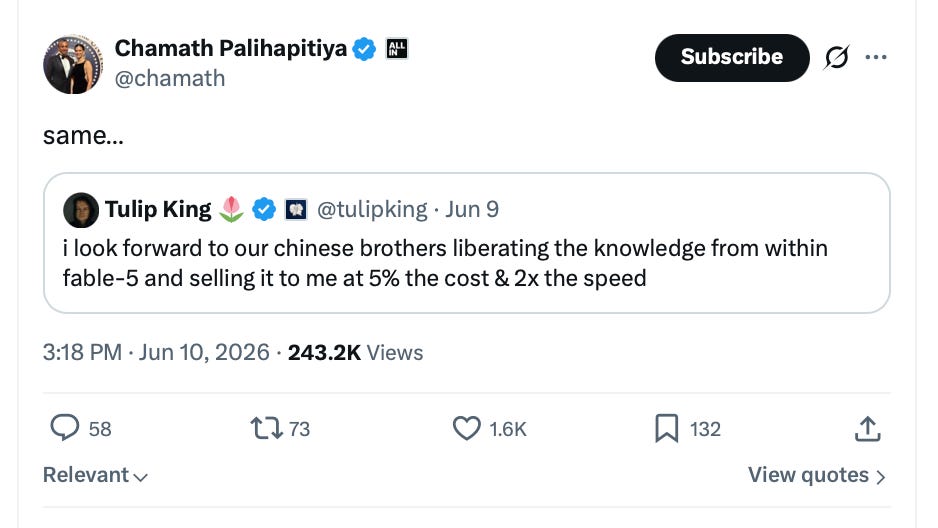
The joke is not really a joke: has intelligence been Temu-ed? The good-enough, cheap-enough version is here to stay, and it seems like whatever the frontier labs build, someone will compress it and ship it cheaper.
The Wire China ran an excellent piece asking a bigger question: will China win AI by replicating its low-cost manufacturing playbook?
Chinese AI companies, from Alibaba and Tencent to Zhipu, keep raising prices in response to rising costs. In manufacturing, scale dilutes cost. In AI, heavy usage means higher costs. Agents can raise per-user infrastructure costs 10 to 100x, and every botched task compounds the bill. Zhipu hiked subscriptions 30 percent this year just to maintain service levels. The takeaway I guess is that tokens are not Shein dresses.
Here’s what I told The Wire China:
“The prevailing assumption was that AI might follow the same export playbook as Shein and Temu: compress costs, scale globally, and let price do the work. But now the illusion of cheap AI is breaking down.”
But setting the economics aside. The Chinese labs are obsessed with Claude: distilling Claude, benchmarking against Claude, and what comes out the other end is “constitution by distillation… a ghost of a ghost in the shell.” The sheer volume of Red Note creators posting distillation tutorials is giving me anxiety just thinking about it.
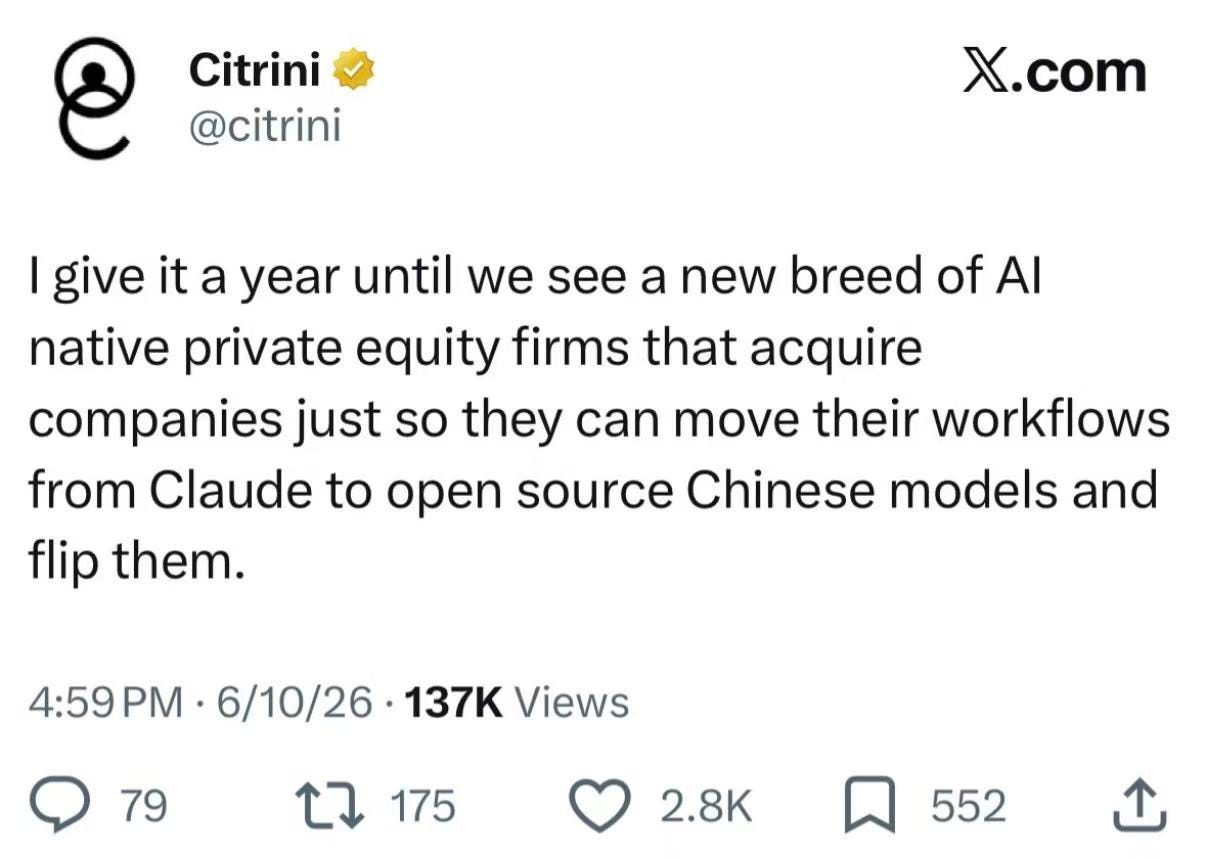
But is distillation, in some ways a proxy for productivity and endless betterment, the end-all and be-all?
Claude has a philosopher on staff thinking about the character and ethics of the model. To me, that’s a soft-power play. The updated soft power in the AI era is what I’ll call zeitgeist-fluency. Joseph Nye defined soft power as the ability to get others to want what you want through attraction rather than coercion or payment; zeitgeist-fluency is observing the subtle cues of the moment, saying out loud what’s already on everyone’s mind, and nudging from a place of authenticity, but also completely in service of specific objectives. Hard power is capex, like data centers—and the capex is staggering: Microsoft, Alphabet, Meta, and Amazon are expected to spend more than $670 billion this year, up from $410 billion last year, and yet America’s data-center build-out is falling way behind schedule. More than 60 percent of the capacity planned for 2027 isn’t even under construction.
Cluely’s Roy Lee seems to have figured out zeitgeist-fluency with no philosopher on staff. I went on my favorite Mandarin-language podcast Pixel Perfect 新新人类 to talk about Cluely, the AI company that started as an interview-cheating tool and is now far better known for its unhinged short-form videos than for anything it sells. We barely discussed the product, which is probably the most accurate coverage Cluely could ask for because the product doesn’t even always work. But Cluely understands that zeitgeist-fluency is soft power, and it matters more as the threshold for building something that works keeps dropping. Hiring Remy Zee, the creator who blew up impersonating Chinese international students and, subsequently, Costco Asian dads, was the best business decision Roy Lee made. The frat-house culture of looksmaxxing, protein worship, and company-reimbursable Hinge Pro accounts is the content.
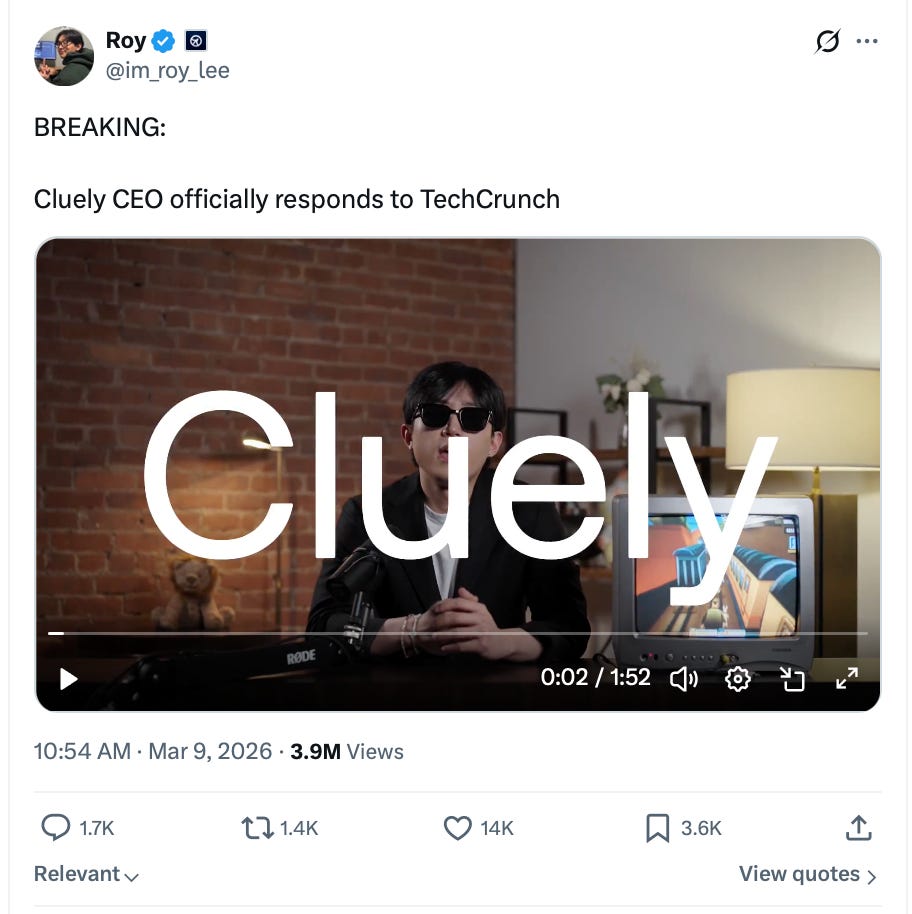
When TechCrunch reported that the $7 million ARR figure Roy Lee once given them was incorrect (the real number was > $5.2 million), Roy Lee admitted it himself on X, then grabbed a mic, put on sunglasses, and posted a diabolical two-minute response video.
He took down TechCrunch in ways TechCrunch could not take him down : the confession went viral and hell broke loose. Roy is the antithesis of the crisis protocol, and what an Edelman, would ever advise.
Roy Lee did not have to unlearn the playbook. And that’s a good thing because skipping that playbook is the playbook now. Gatekeeping in the original sense, deciding what’s right, what’s wrong, and what’s important enough to deserve attention, has gone out of style. Distribution used to be granted by institutions in the form of a slot, a shelf, a news column; it now runs on knowing what the feed wants before the feed does.
There’s a bigger story here, one we really get into on the pod, about Asian men in tech who spent decades following rules, excelling, and staying invisible within a path of upward mobility. The AI moment cracked open a new path, and they are competing for discourse power, capital, and attention in ways their parents wouldn’t recognize. This audience resonates with Roy because he was that guy. His pitch that stability and conventional success, the $400K job at Citadel or McKinsey is a rotten deal, hits home with the audience already ready to take the leap of faith and gamble.
Is Roy Lee is a genius or a symptom?That is the wrong question to ask.
Another zeitgeist-fluency moment this month is Adidas. Juliana Ong did an amazing report for Canvas8 about Adidas’s comeback in China. After years of revenue decline and waning cultural relevance, Adidas staged a remarkable comeback by shifting from a global-centric model to a glocalized one in China by embedding cultural authenticity beyond marketing and into its core business DNA.
Western brands still do plenty of cringe-worthy attempts at commercializing cultural symbols. To truly play in the realm of Guochao, brands need to communicating cultural potency in a way that resonates with an increasingly discerning audience. It’s the deep knowledge of China’s meme and pop culture across the board, and execution with humility.
Adidas took the zeitgeist-fluency test at a corporate scale recently. A translation mistake (“around town” to “go into the city 去城里办事“) that could have been a PR disaster transformed into a viral brand moment.
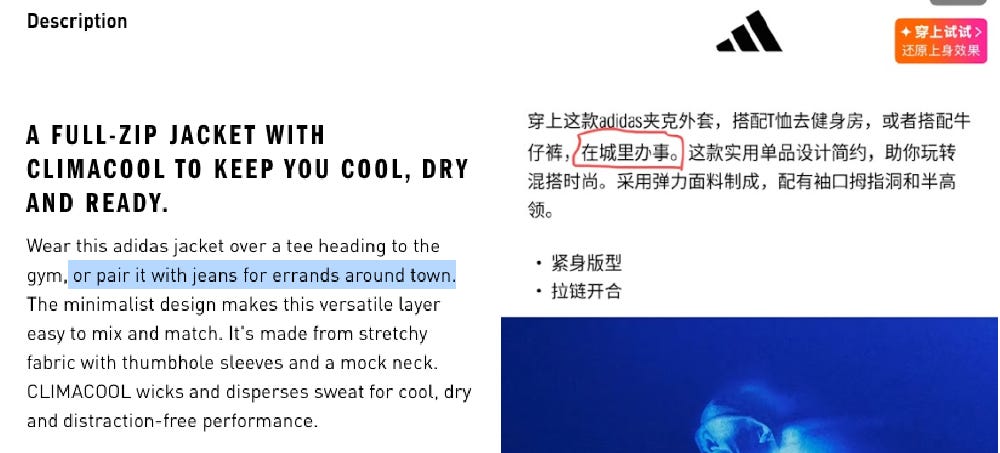
As Manya Koetse expertly explains, the issue was cultural mistranslation. In Chinese, 进城办事 sounds formal and bureaucratic, closer to handling official affairs at a bank, notary, or police station than running out for eggs and milk. To many Chinese netizens, the phrase conjured an old villager cycling into the county. It could have been a PR crisis of cultural insensitivity.
Chinese netizens ran with it and the memes were epic. Instead of correction, Adidas leaned into the mistake and dropped official 进城办事 tees and now it’s a limited edition selling for 448 RMB and capped at 50 T-shirts at day. Whoever led this turnaround gets 100% on the zeitgeist fluency exam with a gold star.
The world is more borderless than the geopolitical headlines. Knowledge, capital, and memes cross oceans faster than any institution can gatekeep them. Zeitgeist-fluency is now a coveted asset.