

Red Note Signals #3: Taiwan’s Red Note Ban and the Politics of Safer Targets
Taiwan’s recent decision to block Red Note turned into a textbook case of the forbidden fruit effect, where what is restricted instantly becomes more desirable.


Much ink was spilled about Red Note’s “TikTok refugee” moment, when U.S. ban fears briefly turned the app into a place to flee to. The wave ebbed once TikTok stayed online. The irony is that the refuge is now on the receiving end of a ban. Red Note is blocked in Taiwan, and the backlash looks familiar: users treating restriction as both provocation and proof of the platform’s cultural value. The original sin is the same one TikTok can’t shake, and neither can Red Note: China affiliation.

Politics aside, Red Note has become a governance headache in Taiwan precisely because it functions as a networked public where meaning is produced bottom-up. For Taiwanese authorities, that matters because once content circulates through peer-to-peer ties and platform-native behaviors—reposting, stitching, parody—it becomes harder to attribute intent, enforce boundaries, or contain spillovers.
This is even more true when the platform sits outside local jurisdiction and compliance mechanisms. As content travels across communities, it gets re-contextualized. The “same” message can be read depending on the audience’s cultural and political frame, especially once it crosses borders.
In #3 of Red Note Signals, Peiyue analyzes Red Note’s precarious position in Taiwan.
Taiwan’s Red Note Ban and the Politics of Safer Targets
By: Peiyue Wu
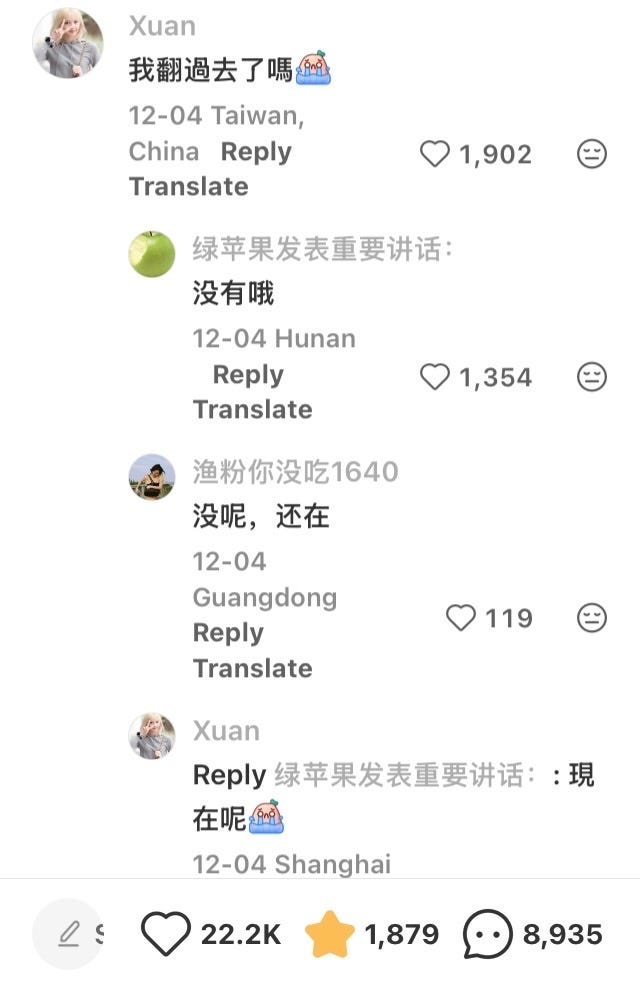
On December 4, the interior ministry ordered telecom operators to block the Chinese social media app for one year, citing rising online fraud and “lack of cooperation” from its Shanghai-based operator. On the eve of the ban, Taiwanese users flooded Red Note with farewell posts, while mainland Chinese users quickly shared VPN tips. These were the same tools they had long used to access overseas content or to “re-enter” China’s internet to stream domestic platforms while studying or working abroad.
Within hours, Taiwanese users began testing their new digital locations in comment sections. Some appeared as Australia or Japan. Others suddenly showed up as Shandong, Anhui, or Liaoning. This visibility was made possible by a 2022 rule introduced by China’s Cyberspace Administration requiring major platforms to display users’ IP-based location, a measure originally designed to curb misinformation.
Taiwan’s own Digital Development Ministry data highlights the inconsistency of the ban. Facebook remains the largest conduit for scams, with over 51,000 cases in the past 30 days, followed by Threads and Instagram. Red Note recorded just 1,706 cases over two years, far below what Meta platforms see in a single month. If fraud were the only criterion, Red Note would not be an obvious target.
That disparity has fueled public skepticism. Within days of the announcement, Red Note’s download ranking in Taiwan surged to the top of app store charts, despite the platform already having roughly three million users on the island – nearly 15% of the population – before the ban.
This echoes what happened earlier this year when TikTok faced a potential ban in the United States. Red Note unexpectedly benefited from a spillover effect, and the influx of users from TikTok to Red Note became known as the “TikTok refugees.” Each attempt to restrict the platform seems to reaffirm its cultural value, reframing it into a symbol of digital autonomy.
Why Red Note Instead of TikTok
Taiwan has long debated banning TikTok, largely due to concerns that Beijing-backed information campaigns could influence elections and spread disinformation. During the past election cycle, research from RFA suggested that TikTok’s viral recommendation system may have contributed to the spread–and in some cases the amplification–of conspiracy narratives around vote-counting irregularities.
Yet banning TikTok outright carries political risk. For a government that prides itself on democratic values and freedom of expression, doing so during or around elections could easily be criticized as self-serving censorship.
As a result, Taiwan opted for a softer approach toward TikTok. Authorities restricted its use on government devices, expanded funding for fact-checking networks, and invested in public media literacy to counter information warfare.
Red Note occupies a different position in the cultural zeitgeist. It plays a much lesser role in electoral mobilization, which makes it politically safer to target as a platform. More importantly, it presents a different kind of challenge for the Taiwanese government. It is one of the few platforms where ordinary users from mainland China and Taiwan interact directly.
The Uncomfortable Bottom-up Familiarity
What makes Red Note uniquely sensitive is not top-down propaganda from Beijing, but the intimacy of everyday interactions among its users. The platform facilitates exchanges on travel tips and consumption habits. Viral moments often emerge from cultural remixing, such as a Taiwanese lawmaker’s dramatic speech line being transformed by mainland musicians into a meme-like internet anthem.
Other mundane topics include dating norms, gender expectations, or why some Taiwanese women perceive mainland men as more traditionally “masculine,” including differences around paying for meals.

These interactions cultivate non-political bonds that are difficult to regulate precisely because they unfold through everyday life. They humanize the “other side,” not as a looming geopolitical threat, but as millions of individuals with distinct accents and cultural references.
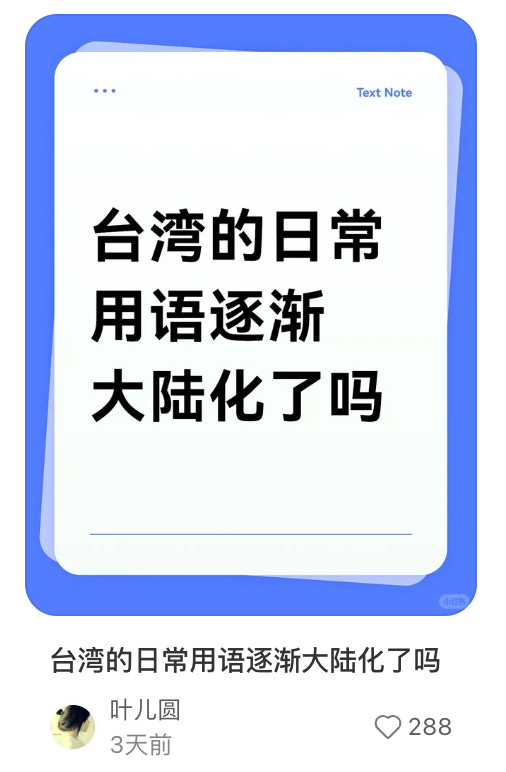
One widely circulated post asked whether mainland slang and linguistic habits are quietly slipping into everyday Taiwanese speech. Hundreds of comments followed, with users listing phrases they have unconsciously adopted.
After all, language is not merely a means of communication, but a carrier of shared context and identity. It can form a basis for mutual recognition that is far harder to counter than any explicit political message.
For many Taiwanese users, Red Note also serves as a window into professional and lifestyle opportunities on the mainland, particularly in Beijing and Shanghai’s tech and advertising sectors.
This may be precisely what makes Red Note more threatening than TikTok in the eyes of policymakers. Ironically, attempts to suppress curiosity and limit recognition of this quiet soft power can backfire, making the platform even more desirable. Once users realize the value of these connections, banning the platform only strengthens its allure.
 | A guest post by
|
It's the Streisand effect in action.
I wonder if the Taiwanese government (or specifically the DPP) have ever thought about the possibility that Taiwan's culture is also influential and attractive to those on the other side, and that interactions on places like Red Note also helps Taiwan accumulate much needed good will among ordinary Chinese people.