

Red Note Signals #4 CES 2026 Shows the U.S. Market Still Fuels China’s Tech Dream
CES was a big China go global party, was it worth it?


Last week, my Red Note feed was inundated with CES attendees and influencers in the wild, pontificating on the future of tech. In the same scroll, I will see recruit for Burning Man at CES, hot takes on the future of Buddhism in the age of AI, endless CES vlogs, conspiracy theories that Unitree robots are actually operated by remote control, and Chinese hanfu creators drifting through booths with tech as the background for selfies. Roborock (yes, the robot vacuum company) brought a full-on dance troupe. There’s Glyde, a “smart hair clipper” that promises the perfect fade—though their demo could use a happier customer (pic 2 below).


Nikkei rounded up a set of surprisingly useful AI innovations at CES 2026; Wired reported that VR glasses are suddenly everywhere. Robot vacuum brand Dreame is even rolling EVs onto the floor—while both the EV company and Dreame try very hard not to acknowledge the connection.
Meanwhile, Kuaishou, China’s TikTok Douyin competitor, is pushing into AI video via Kling AI, aspiring to be China’s answer to Sora—or to grab a slice of the microdrama boom by using AI to compress production time.
But as you’ll see in Peiyue’s reporting, CES didn’t just feature Chinese companies—it felt like a party hosted by them. Beneath all the spectacle, do we really need three dozen AI eyewear products when Meta has just sold over 2 million pairs? Is the TAM worth the involution?
That’s the tension that will keep surfacing as this wave of Chinese companies going global continues.
CES 2026 Shows the U.S. Market Still Fuels China’s Tech Dream
By Peiyue Wu
Flying halfway across the globe to exhibit in the United States, many Chinese startups and tech companies arrived at CES only to find themselves surrounded by familiar faces. On the show floor in Las Vegas, it sometimes felt less like leaving China than wandering through an overseas extension of Shenzhen’s Nanshan Science and Technology Park.
Despite a noticeably higher U.S. visa rejection rate for Chinese applicants compared with last year, the Consumer Electronics Show, held from January 6 to 9, still drew a strikingly strong Chinese presence. The annual trade fair, widely seen as a bellwether for global innovation, was jokingly referred to within China’s tech circles as the “Chinese Electronics Showcase.”
While the number of mainland Chinese exhibitors fell from 1,212 last year to 942 this year, Chinese companies remained the backbone of several emerging categories. Among the 38 humanoid robot exhibitors, 21 were from China, accounting for 55 percent. In AI smart glasses, Chinese brands made up nearly 70 percent of the field, with 16 out of 23 exhibitors.
CES has come to resemble a pilgrimage. On RedNote, one AI-powered smart gardening startup even boasted about exhibiting at CES on a budget of just 70,000 yuan (roughly $10,000). Company size and capital strength mattered less than the act of participation itself. Simply showing up had become a signal of ambition.
This enthusiasm for “going global” appears oddly out of sync with the still-frozen political climate between the U.S. and China. Yet for Chinese entrepreneurs, geopolitics often feels abstract compared with more immediate pressures at home. A slowing domestic economy and intense competition have made earning U.S. dollars and accessing overseas markets one of the few remaining sources of momentum. Ironically, it might be precisely the distance and unfamiliarity of the U.S. market that allow Chinese founders to project bigger ambitions and imagine wider possibilities.
Major Chinese brands were trying hard to cut through the noise. Lenovo went big this year, renting out Las Vegas’ landmark Sphere to host its own keynote event. Meanwhile, at TCL’s booth, a Chongqing-based influencer known for mimicking Donald Trump’s accent in English-language parody videos made an appearance. Nicknamed “Chinese Trump” online, he was already familiar to many U.S. audiences even though this trip marked his first visit to the country.
Skepticism followed closely behind the hype. Critics on Chinese social media argued that CES is becoming an influencer-driven destination. Small content creators flock to the show to capture traffic, while exhibitors polish their brand image rather than seriously pursuing overseas markets, only to return home and refocus on China.
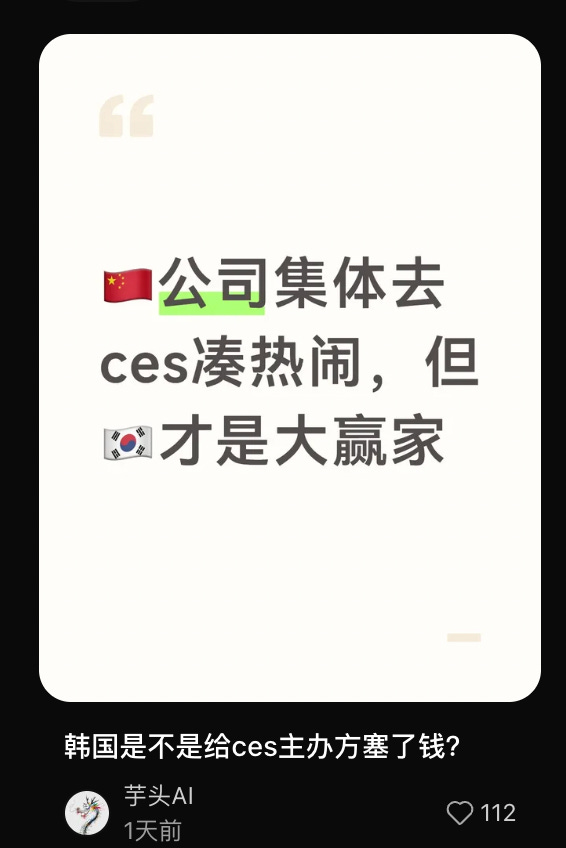
Seen this way, CES resembles a Chinese social media carnival. Even as official tech outlets hailed the strong Chinese turnout as proof of rising global influence, individual bloggers struck a more cynical note. Some pointed out that Korean companies swept most of the major CES awards. Others mocked products they felt were half-baked or embarrassing exports, such as a “smart hair clipper” that claims to sense speed, tilt, and angle in real time to prevent uneven fades or overcuts.
Yet even amid the noise, there are signs of genuine evolution. Compared with last year, product thinking has matured. Rather than awkwardly grafting AI features onto existing products, more companies are designing hardware around AI as the core logic. For example, Lenovo’s laptops with expandable screens that are able to rotate based on facial recognition to track movement during video calls treat the laptop as a quasi-robotic system.
Whether CES ultimately delivers Chinese exhibitors meaningful U.S. connections, genuine customer interest, and solid orders, or merely another social media badge to show off back home, remains an open question. What is harder to dismiss is the momentum on the ground. The enthusiasm to test the U.S. market, to be seen, and to compete on a global stage is still moving forward.
To read more previous editions of Red Note Signals:


 | A guest post by
|
love these updates :)
Not bad