

Shein is at a Very Chinese Time in Its Life
More on my Tech in Asia Op-Ed, Manus, and China-shedding

In a previous piece on Calling the Shots, I wrote about the end of Shein’s China-shedding. I went a step further in my latest Tech in Asia op-ed, focusing on the IPO prospects and why Shein’s listing will proceed at a discount.

The geopolitical reality: the perception of abandonment from China’s perspective is now a deal breaker.
My editor Peter Cowan sharply stated the broader condition:
Shein’s long-running attempt to position itself as a “global company” may have reached its breaking point. As geopolitical tensions rise, firms built on Chinese industrial ecosystems are finding it harder to sustain that strategic ambiguity.
With New York and London off the table, Hong Kong has emerged as Shein’s most viable and likely only IPO option. That path comes with its own logic. If Shein lists in Hong Kong after years of presenting itself as a Singapore-based global company, the listing itself becomes an admission: offshore restructuring has limits as a strategy for escaping political scrutiny.
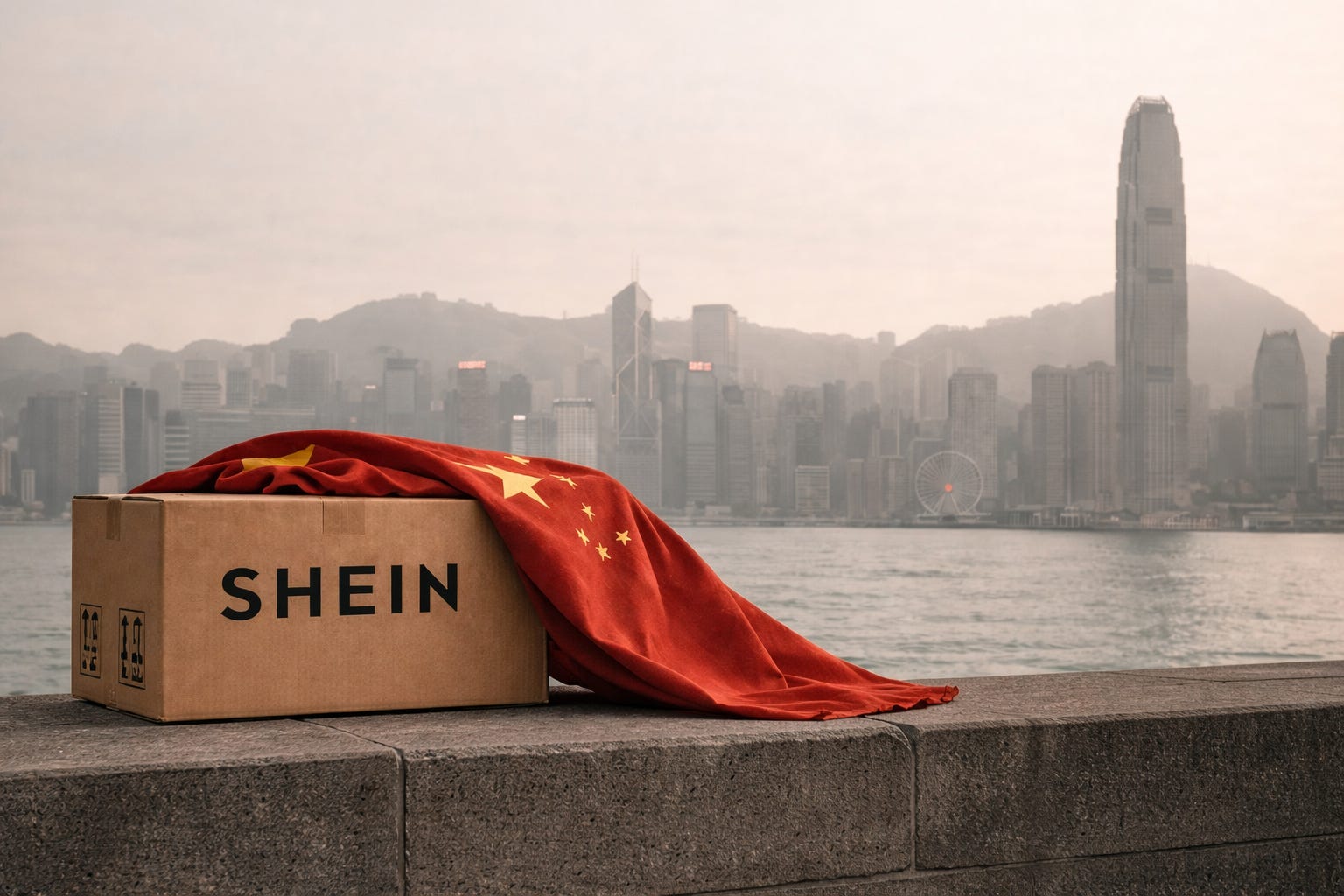
Shein is now in the most Chinese moment of its corporate lifetime. While its core manufacturing ecosystem has no real Western equivalent, sustaining that advantage depends on continued access to China’s industrial base, which rests on political trust and careful signaling.
For a company that spent years performing China-shedding, the market will expect a cleaner answer to the question of identity.
The pattern is now spreading across the sectors. Global Chinese companies like Shein, Manus, and TikTok spent years distancing themselves from China to access Western capital and prove they were American enough. The Chinese government is now making that calculus increasingly untenable.
This week, the New York Times reported that the Chinese government is taking actions to penalize people linked to Meta’s $2 billion acquisition of Manus, in an apparent effort to discourage Chinese AI executives from moving businesses offshore to Singapore and other places. The message is loud and clear: the relocation playbook now has consequences.
Meta’s statement to NYT was notably blunt :
“The transaction complied fully with applicable law,” the company said. “The outstanding team at Manus is now deeply integrated into Meta. We anticipate an appropriate resolution to the inquiry.”
That last line reads like an ultimatum (almost certainly drafted by lawyers) and signals that Meta is treating this as a matter to be managed, not a negotiation.
China’s National Development and Reform Commission, a high-level ministry that oversees economic planning including AI, called in Meta and Manus executives for a meeting late last week to express concerns about the deal. And the Chinese Embassy was drawn into the inquiry. .
In the midst of all this, Manus announced that Meta has connected it to Instagram’s Creator Marketplace, and the deeper integration across Meta’s marketing stack is already happening.
The question is whether Beijing reads that as defiance, or whether the product-level work is proceeding with some form of quiet blessing, or Manus is simply proceeding as if the warnings don’t apply to the product roadmap. That ambiguity cuts both ways.
Shein has spent years cultivating a global persona while quietly signaling loyalty to the Guangdong government, careful to keep that news from traveling too far. Manus is moving ahead with its product integration roadmap while simultaneously managing an active investigation in China. Both companies are running two tracks and counting on each audience not looking too closely at the other.
That calculation is getting harder to sustain. Strategic ambiguity, it turns out, is not a strategy. If we learned anything from TikTok, Manus, and Shein, it is that China-shedding satisfies no one.
On why China-shedding is an untenable strategy in 2026, please read Calling the Shots Field Guide #1. Send me a message and I will send you the full deck.