


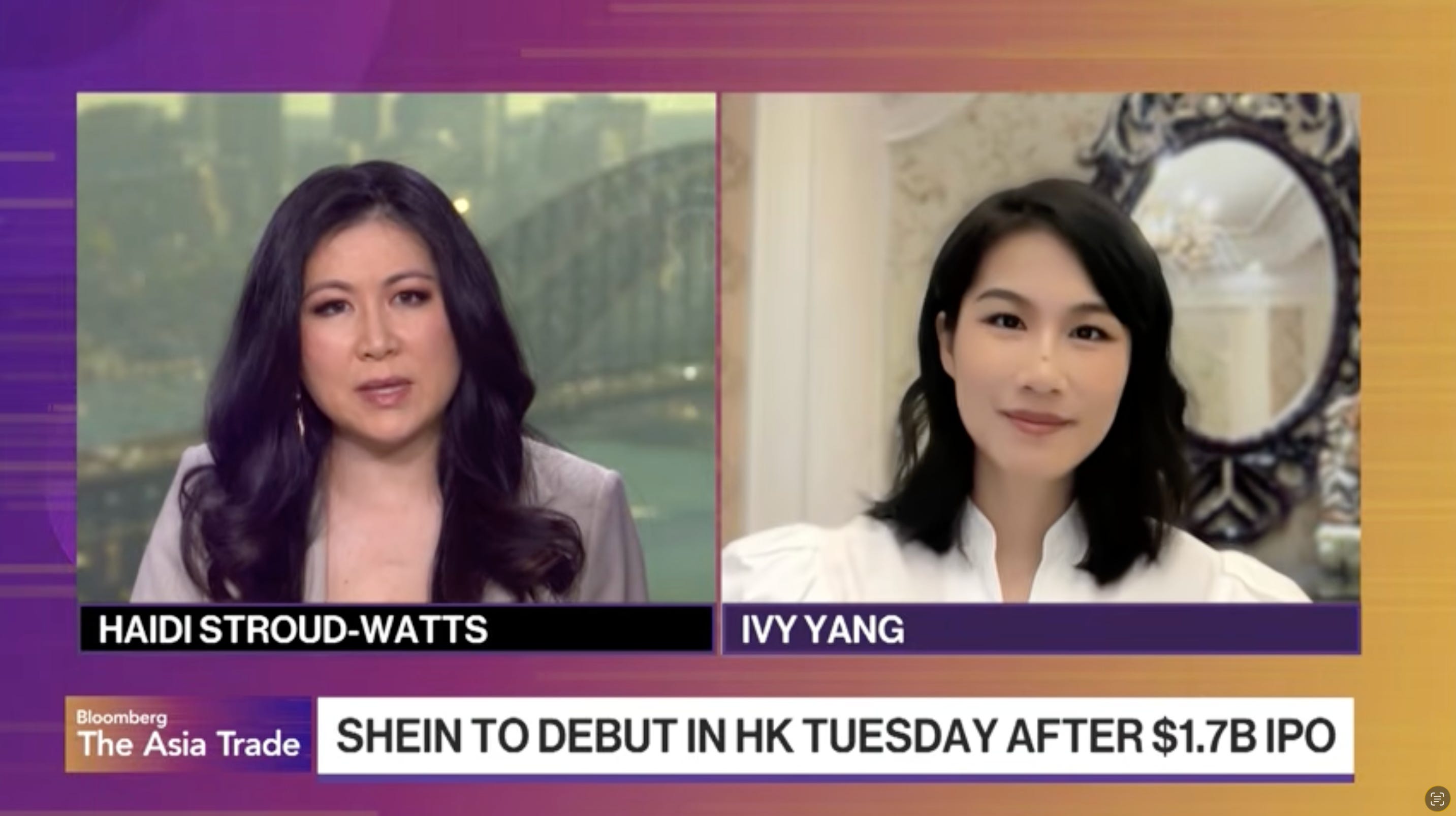
I went on Bloomberg TV ahead of Shein’s September 1st Hong Kong IPO, and I joked that the search for a stock exchange to list is like the story of Goldilocks. New York was too hot; London was too cold. Hong Kong was just right.
It’s been more than three years, and Shein has shaved off ¾ of its peak valuation of close to $100B in 2022. Shein filed confidentially in New York in November 2023. It got FCA approval in London in April 2025 and walked away a month later without Beijing’s sign-off. It then filed in Hong Kong in July 2025 and waited until July 10 of this year for China’s securities regulator to clear it. To list at home, it needed permission from home.
So the significant thing about September 1 is that it happened at all. Shein is finally out of geopolitical limbo, but it is listed at a heavy geopolitical discount.
The reality is that it couldn't list at the optimal time frame, and an investor base more wary of potential risk and momentum for future growth impacted by tariffs is the geopolitical discount. And it is not going away because a bell rang.
But to be fair, 2022 is a bad yardstick to evaluate Shein in 2026. That number came from a zero-interest-rate environment, an available de minimis exemption, tariff conditions Shein could route around, and a market that had not yet decided online retailers were a political question. None of those conditions exist now. Shein is not a company that lost three-quarters of its value. It is a company priced by a different world. (If I were advising Shein, this is the point I’d go all in and repeat in every single briefing and interview).
It is also competing for attention in a market that has something shinier. Greater China listings have raised over $54 billion this year, up from $46 billion all of last year, and the AI cycle is absorbing the risk appetite that would otherwise have found its way to a fashion retailer. Set Shein next to a chip company and what investors see is a business with a luxury gross margin, 67.9 percent, and a supermarket net margin, 4.9 percent.
Fulfillment and marketing costs are also rising for Shein. The US de minimis exemption ended in May 2025, and duties now run from 10 to 87.5 percent. The EU added a parcel levy of about three euros in July, and Shein says the hit could match or exceed the American one. Every order is now a parcel that costs money to move, and Temu and Amazon are bidding for the same shopper.
Which is why Shein is trying to make its money earlier in the value chain. It is turning its supply chain into infrastructure other brands can rent, and it is buying brands that already have goodwill, like Everlane, an environmentally concious millennial brand. But becoming part of the supply chain is a harder businesses with thinner margins than selling a dress and building a brand. But there's logic underneath the pivot: 7,500-plus contracted manufacturers, about 4,700 new styles a day, and inventory that turns in 36 days against Zara’s 88 and H&M’s 138. That network only works if it stays busy. Keeping suppliers fed is what keeps them willing to run small batches on Shein’s terms. The day those factories decide Shein is no longer the bread and butter, they jump to Temu or whoever is filling their lines next, and Shein’s edge goes with them.
There is a second reason the timing, and whether to abort the IPO at all, was not really Shein’s to choose. If the company had not sold shares by December 31, it owed nearly $4.4 billion in cash to holders of its convertible redeemable preferred shares. Going public triggered a different bill: roughly $3.5 billion to early investors, including $1.3 billion in guaranteed returns at 8 to 12 percent and up to $2.2 billion in compensation for the valuation drop. The IPO raised $1.77 billion. For most companies, a listing is the culmination of years of growth, a public validation of the business and its ambitions. For Shein, it was also a payment deadline.
The prospectus also lacks a clear vision for the future. Shein says 40 percent of the proceeds will go toward technology: more cloud and server capacity, AI-assisted demand forecasting, warehouse automation, digital inventory management and as many as 2,000 new technology hires. Another 40 percent will fund global expansion through performance advertising, brand campaigns and larger local marketing teams in the United States, Europe and other growth markets.
Its broader growth plan follows the same practical logic: attract more customers, add new product categories, bring more third-party merchants onto the marketplace and offer Shein’s supply-chain, manufacturing, fulfillment and marketing infrastructure to outside designers and brands.
These are credible ways to spend capital. They could make Shein’s existing system faster, widen its customer base and allow acquired or partner brands to grow through the company’s vast manufacturing and distribution network. They still leave the central question unanswered: what kind of company does Shein intend to become? Bloomberg reports that founder Sky Xu told investors the Shein brand could no longer sustain its previous pace of growth, making acquisitions and brand partnerships the next engine.
The purchase of Everlane offers the clearest path forward: Shein can buy an established label, plug it into its supply chain and improve its reach and margins. Buying growth is a strategy. Buying goodwill instead of earning the brand trust may also soften Shein’s reputation. But investors with a longer time horizon may question whether there is a next act for a company whose original growth machine has reached its limit.
In February, I wrote that Sky Xu’s appearance at a Guangdong provincial conference was the end of Shein’s China-shedding.

The title next to his name at the Guangdong Provincial Party Committee conference read: Founder of Guangzhou Shein International Import and Export Co., Ltd. Guangzhou. He told the room that “Guangdong is Shein’s root and where we began,” and pledged 10 billion RMB to build a smart supply chain in the province. After four years as a Singapore company and distancing itself from its China roots, it was a homecoming at last, and more importantly, an expression of loyalty that paved the way to the Hong Kong IPO.
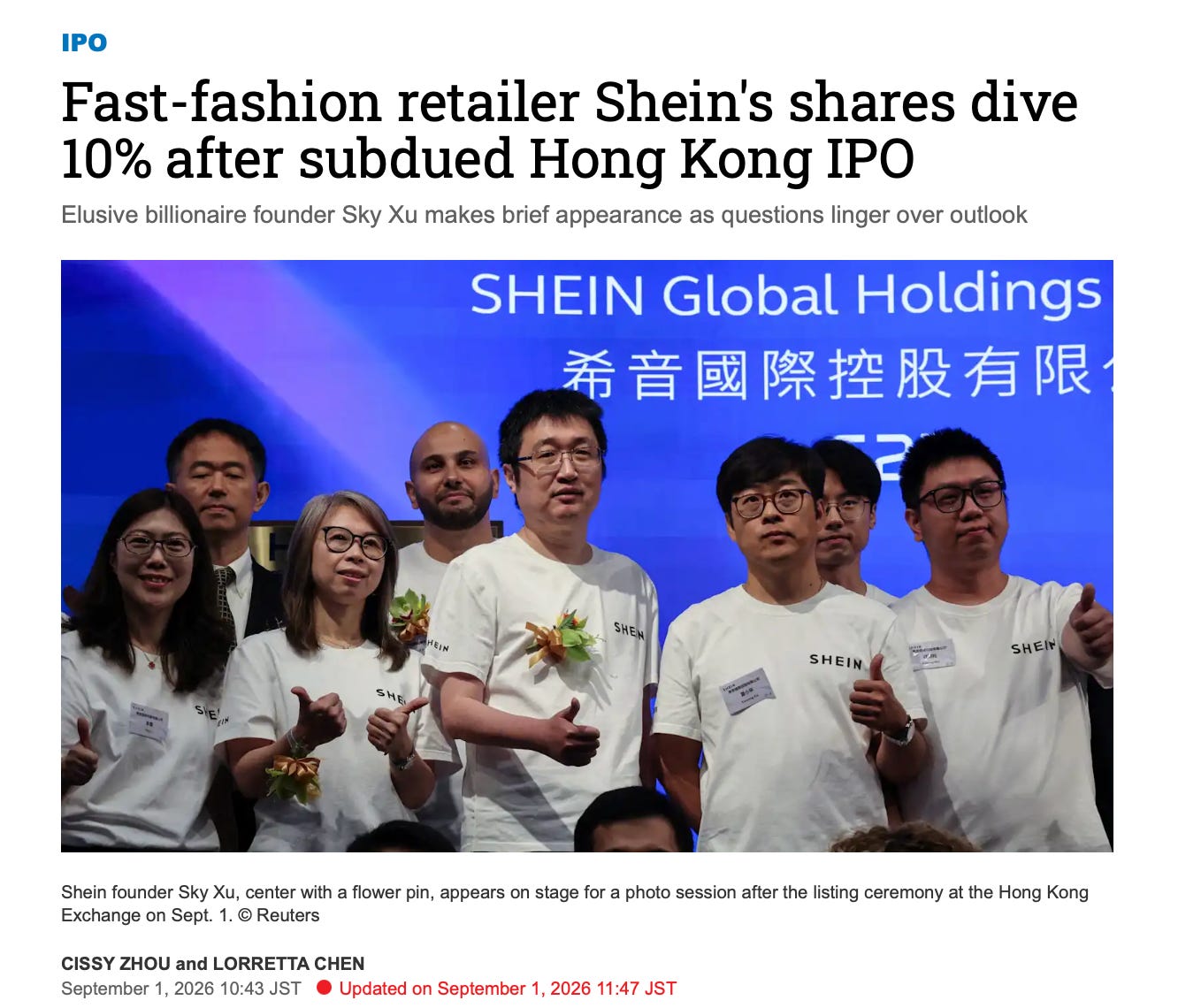
Six months later, Xu stood on a stage at the Hong Kong Stock Exchange with a flower pinned to a white Shein T-shirt, in front of a screen that read SHEIN Global Holdings. Shein has changed what it says it is at every stage that required it, and those changes have worked well enough to get the company here.
The Goldilocks story did not end when she found the bowl that is just right. It ended when the bears came home. Shein found its exchange on the third try, at a quarter of its peak valuation and just before the bill came due. Now the bears are home.