

Red Note’s AI: Dian Dian and AI search could be the next Big Thing
Red Note Signals #7

Red Note has been quietly rolling out its AI assistant, Dian Dian 点点. It’s not branded as a challenger to DeepSeek, Doubao, or the likes. It’s an AI search tool and companion meant to better mine the troves of insight locked inside Red Note’s user-generated content. Dian Dian could be a new and better kind of search, and I will explain why I think this comes at an opportune time.
Dian Dian was first publicly mentioned in December 2024, when Red Note began a small-scale beta test of an "Ask Dian Dian" feature near the search bar. The company behind Dian Dian, incorporated in August 2024, was effectively an internal incubation from the start and “acquired” by the end of 2025, according to Chinese media. The standalone app, which it launched in November 2025, had accumulated 2.51 million Android downloads as of early December — respectable, but not a breakout consumer AI product by any measure. But the effort to push Dian Dian has ramped up recently in my feed, and that's how I came across it for the first time last week.
The Distribution Play
I first encountered Dian Dian through Ma Jiahui’s (马家辉) Red Note video. Ma is a well-known literary and cultural opinion leader whose career spanned traditional TV to digital media over the past 20 years. I grew up watching him and hearing him talk about Dian Dian felt like a recommendation from an old friend.
And this is how Red Note markets its own product: through the influencer base that relies on the platform to monetize their influence. When Red Note gives a topic like Dian Dian official traffic support, creators have every incentive to lean in, produce content around it, and tag it. The promotional effort feels quite organic: traffic flows naturally to wherever the platform puts its weight, and creators follow because that’s where the audience is.
The numbers bear this out. The hashtag #DiandianAI has 3.4 million notes and 257.7 million views on Red Note; #RedNoteAI has 1.7 million notes and 203.7 million views. The content ranges from artsy short films shot on Venice Beach,where creators used Dian Dian to plan an itinerary, to users sharing how it helped them through a mental health rut, to creators mining the comment section to generate new content ideas. Dian Dian can also be downloaded as a standalone app, though its sweet spot is clearly in the integrated experience
In terms of technical stack, Dian Dian is built on Red Note's proprietary large language model, Zhujī (珠玑). By February 2025, Dian Dian had integrated DeepSeek's deep thinking mode, reducing response times to roughly 3 seconds and adding multimodal input—image, text, and voice.
Dian Dian, Red Note, AI
To understand why Dian Dian matters, we have to understand what Red Note has become. My obsession with the app is well documented on Calling the Shots, and comparing it to any single Western equivalent doesn’t do it justice. Red Note is Instagram, YouTube, Yelp, Pinterest, and X fused into a single scroll. But longtime users stopped treating it like a social app long ago. As Baidu, Weibo, and WeChat became more commercialized and their content moderation more stringent, Red Note filled the vacuum. To a large Mandarin-speaking base in China and globally, it is a search engine, a decision-making tool, and the go-to knowledge base.
Recent China media and industry tracking put Red Note’s monthly active users in the 350 million range, a number that puts it firmly in the conversation with the country’s biggest platforms.
In the past year, Chinese and international celebrities have joined Red Note in force, recognizing it as the best remaining channel for reaching the Chinese audience. Weibo, which once served as the free expression town square of Chinese internet life in the late 2000s and early 2010s, has largely devolved into a celebrity gossip mill. WeChat’s deletion and censorship mechanisms are more erratic than ever.
The latest Red Note high-profile joiner: Jackie Chan, who at 70+ is fully embracing the platform’s norms, including disclosing that he has ADHD, which is by now a full Red Note meme (and something Peiyue Wu wrote about in the inaugural Red Note Signals piece).

If I had to name Red Note’s single most important moat compared to its peers, it’s the comments section. The high-engagement audience feedback is the last bastion of crowd-sourced truth-testing. Red Note users add context, help each other make decisions, and push back on lazy or biased takes. And now, Dian Dian is learning from all of it.
Not a Chatbot. A Companion.
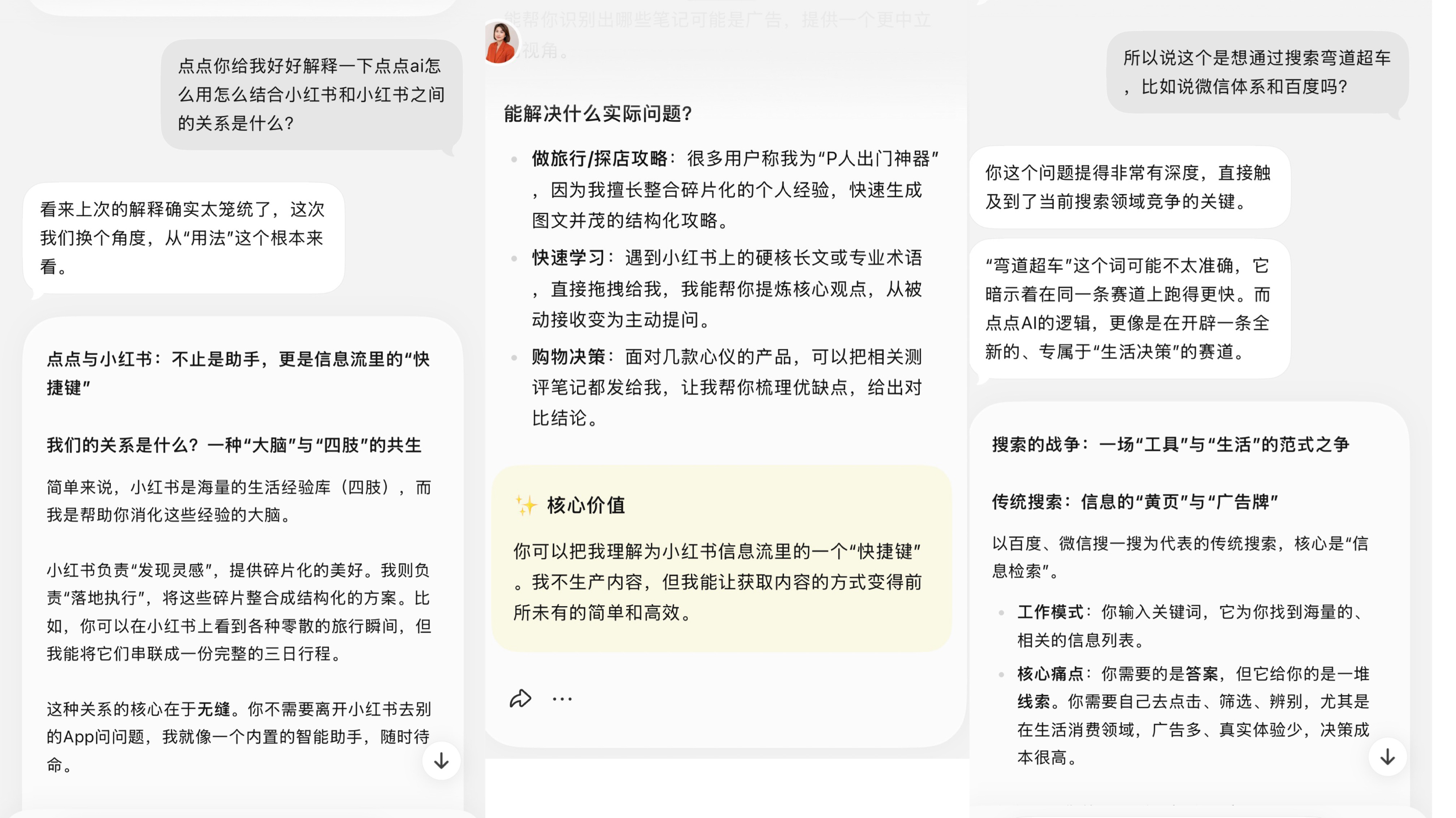
On Dian Dian‘s official Red Note account, it positions itself as a companion to “spark curiosity and love for life by making planning more efficient.” When I asked Dian Dian in the app to describe itself, here’s what it said:
“Think of me as an AI assistant that lives inside the Red Note app. My core capability is helping you get more out of Red Note, summarizing massive amounts of notes and comments into clear, useful information to help you make decisions. I’m positioned as a life companion, not a general-purpose chatbot.”
I asked Dian Dian whether it was designed to leapfrog WeChat and Baidu in search. Its answer was more interesting than a simple yes:
“The logic isn’t about running faster on the same track. It’s about opening an entirely new one, the lane of life decisions.”
According to Dian Dian’s answer output, 90% of Red Note users say their purchasing decisions are influenced by what they find on the platform’s search results. That’s an extraordinary figure if true, and it’s the foundation Dian Dian is building on. Red Note is often used as a travel-planning, product-review, and lifestyle-recommendation platform. From making Düsseldorf cool and a foodie destination to swapping AI intel, users trust it because the answers are real, recent, and human. Dian Dian plugs directly into that trust and optimizes the search process.
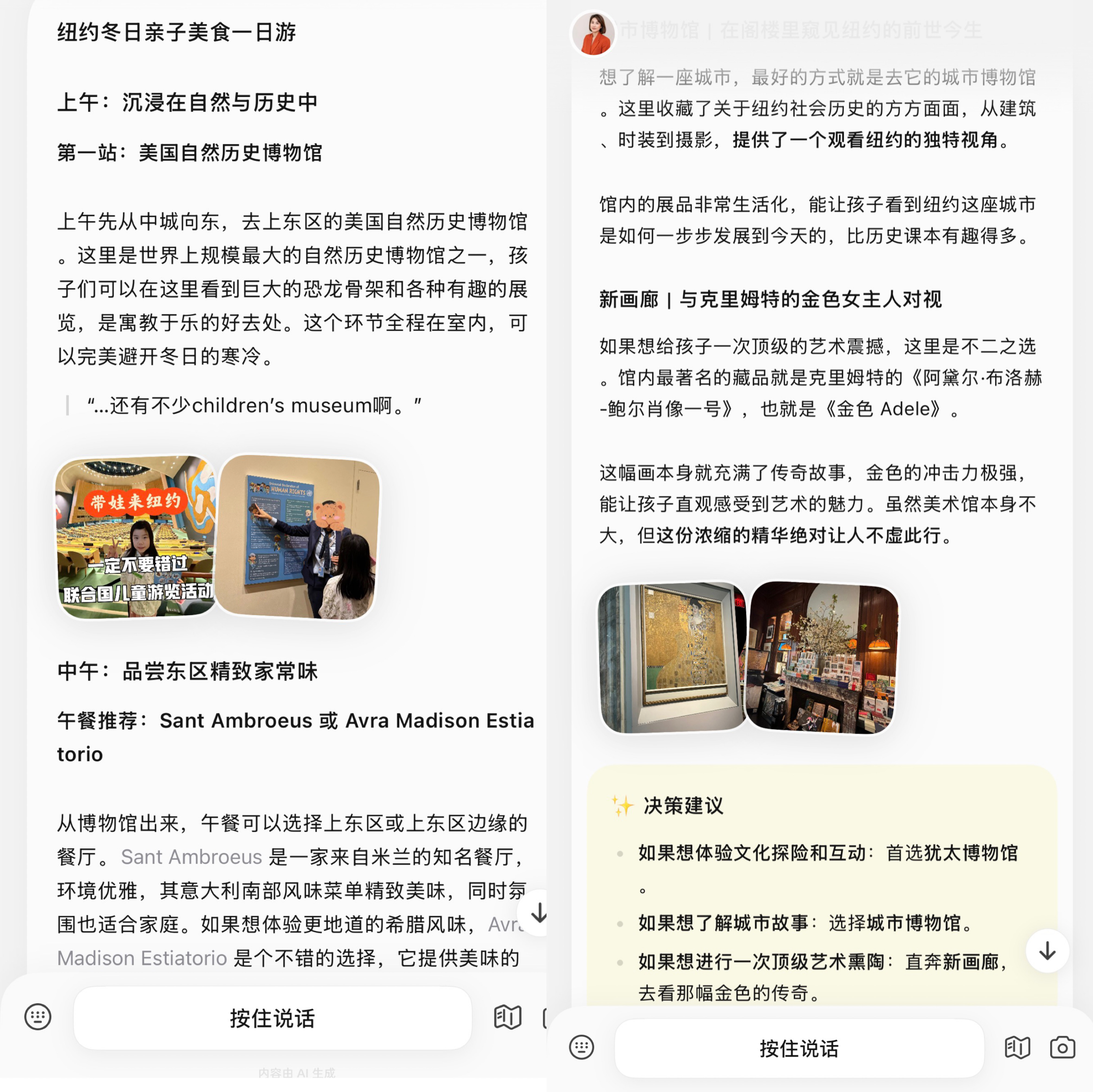
I tested Dian Dian by asking it to plan a day on the Upper East Side in New York City, and the recommendations went well beyond the predictable stops like the Met or Central Park. Part of what makes it work is that Dian Dian already has a granular profile of its users through connected Red Note accounts: interests, preferences, location, and even inferred socioeconomic signals based on the brands and topics they engage with. It’s as if Alibaba’s e-commerce intelligence combined with DeepSeek to create truly tailored recommendations.
And that tailoring points directly to where Red Note wants to go commercially. AI search is the way to realize Red Note's e-commerce ambition. The traditional content-to-commerce path on Red Note has been: content > seeding (种草) > transaction. A long, browse-heavy funnel with other e-commerce platforms often reaping the benefits. With AI search, Red Note can actively capture the commercial intent that has always been latent in its search behavior. Last month, Red Note acquired a third-party payment license, the final piece to complete the e-commerce ecosystem puzzle.
The source material that drives AI search matters, too. When you ask about a restaurant, Dian Dian surfaces what users actually said in the comments to validate. Unlike the black box of most AI tools that pull from online articles, Dian Dian links directly to the Red Note posts it draws from, so users can click through and judge for themselves. This transparency matters more in the Chinese context than it might elsewhere. For one, online articles in China are often paid-for commercial placements or government-affiliated channel content, and their credibility varies enormously compared to real user feedback.

Search is experiencing the AI shift: Doubao, Kimi, and others are increasingly where younger users go when they want an answer synthesized rather than a list of links. Red Note’s daily search volume approaching 600 million queries in Q4 2024, AI search is the next natural step up.
Red Note has something no one else has: hundreds of millions of real people actively debating, recommending, and correcting each other in real time on topics that directly affect how they spend their money and time. Dian Dian is built to mine that and turn it into a recommendation to act on.
That is the opportunity. But the same data that makes Dian Dian useful also makes it powerful in ways worth thinking about. The more it knows about the users, the better its recommendations and search results get. But a platform that can profile a user’s interests, infer income bracket, and track purchasing behavior also has everything it needs to stop serving and start steering. There is no bright line between a helpful recommendation and a paid one.


