In a Nutshell
Jensen’s and Colette’s satorial signals. Jensen came back in a navy Dior jacket instead of his signature leather one: a costume that says second time around. Colette Kress went all in tweed and pearls a boss-in-charge look sent before she had the power to match it.
The CTS Signal Tracker flagged it last week: renting advanced chips to a China-headquartered company now needs a U.S. license, wherever the data center is. That ends the setup where the chips stayed in Southeast Asia and Chinese customers rented them remotely. Bitdeer and every Nvidia partner in the region now have to explain who they rent to.
Crisis PR is about telling one true story, the same way, to everyone. “Business as usual” narrative won’t work, because nobody believes it. Get everyone inside aligned first, and audit what you’ve said in the past before a reporter does.
Jensen is back, and so far, from what I can tell, Dior wins this round, and the biggest losers are data centers in Southeast Asia.

Eleven days after he resigned, Jensen Huang walked back into Nvidia in a navy Dior bomber to the adulation of employees chanting his name. The scene reminded me of the episode of the Korean drama Crash Landing on You where Yoon Se-ri returns in time for her own memorial and to see who was rejoicing. Then she walks into the board meeting where she had been voted out. She takes control, and the housecleaning begins.

“I’m going to be a better CEO the second time around,” Jensen told the crowd.
Let’s start with Jensen’s jacket choice. The Dior navy non-leather jacket is giving second-time-around energy, and we should read the sartorial choices as intentional. Its silhouette is more modest and a departure from his signature leather jacket, the subject of a distasteful New York Times guest essay. (I’m glad the image has since been changed to just a leather jacket zipper.) It’s a similar silhouette to what the public has known Jensen to wear, but in a different color. His new costume is signaling change. It’s subtle, but thank God, Jensen was not ready to downgrade to an Arc’Teryx parka.
The stock took a nosedive when Jensen resigned. And the interim CEO, Nvidia’s CFO Colette Kress, was handed the impossible job of communicating “business as usual.” That is THE worst assignment in corporate communications, because “business as usual” is the one thing nobody believes. If it were usual, you wouldn’t have to say it.
Kress on Mad Money was not exactly confidence-inspiring. I had a hard time putting the two images together as the same person.

In the official photo widely distributed to the media after Jensen’s departure, she looks the part of a tech CFO: a black turtleneck, warm light, and an open smile. On Mad Money, she is in tweed and pearls with her platinum hair pressed straight and a careful closed smile, framed on a monitor between Cramer’s Wall St and Main St signs. The sleek hair is giving boss-in-charge power move, (and now in hindsight) before she consolidated the power.
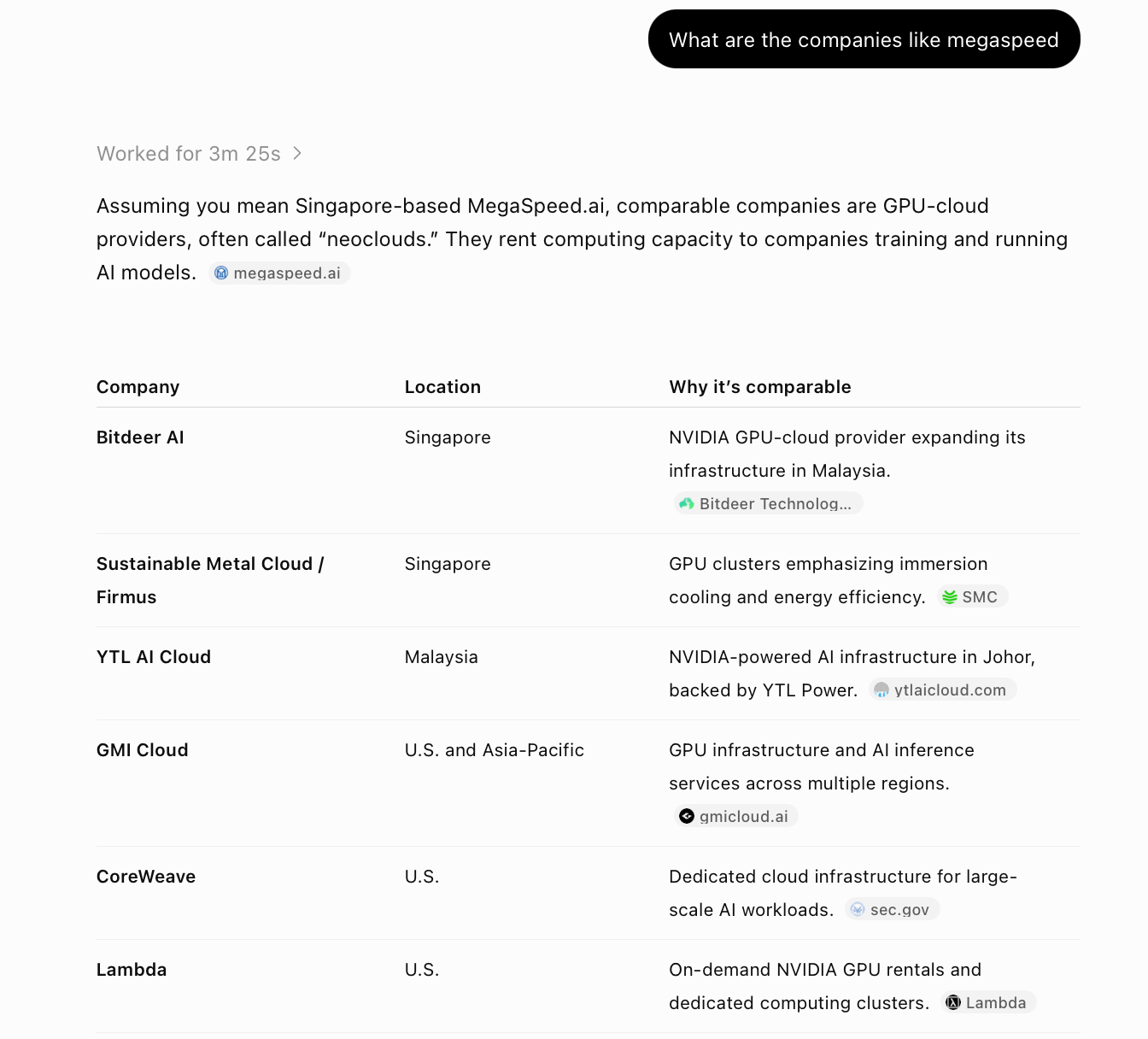
But the reporting really begins now. I asked ChatGPT, “What are the companies like Megaspeed?” First on the list was Bitdeer.
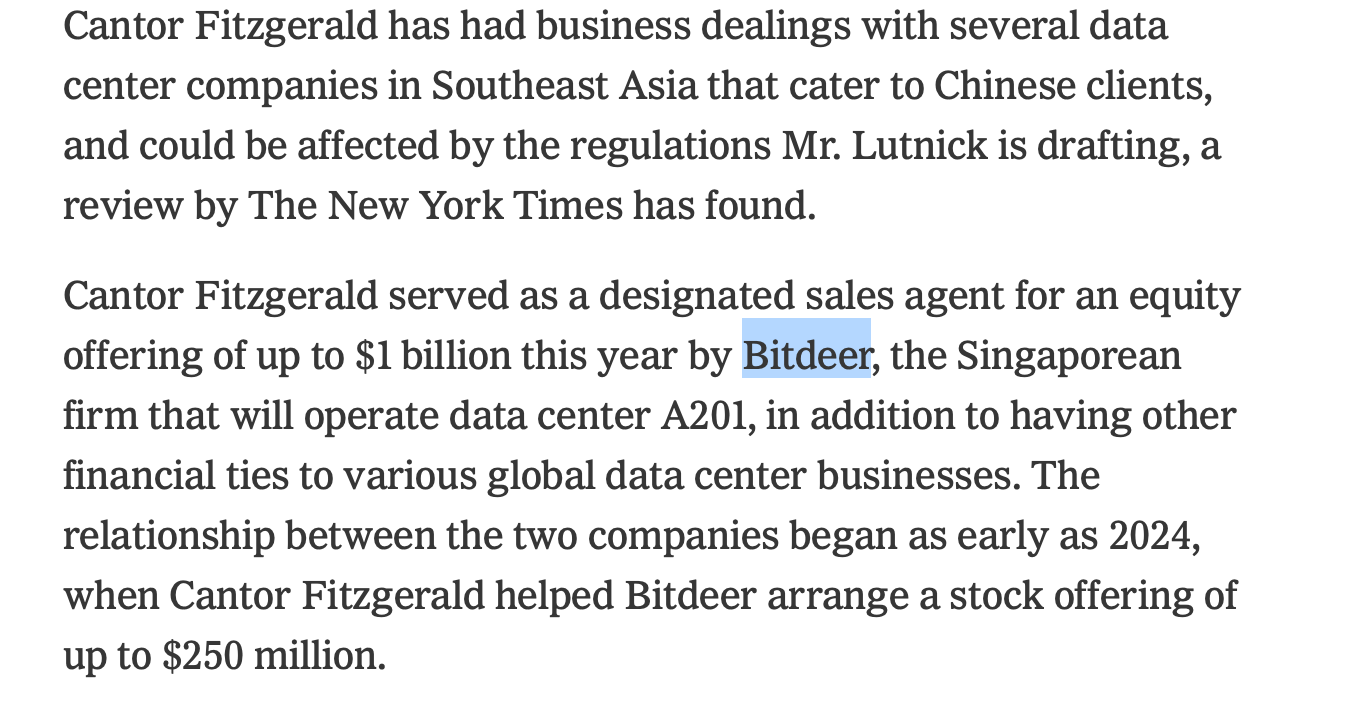
The New York Times had already gotten there by way of U.S. Commerce Secretary Howard Lutnick’s old firm, Cantor Fitzgerald.
Politics and Jensen Huang’s extramarital affairs aside, what fascinates me is how U.S. export controls helped set off a building boom in Southeast Asia. I’ve written ad nauseam about China-shedding, the lengths companies go to in order to play down their Chinese origins overseas. Its cousin, Singaporization, used to be the first order of business.
Manus Shows How China-Shedding Works

Back in May, when I wrote about Manus while the U.S. Treasury was reviewing Benchmark Capital’s $75 million investment in the company, it was unclear whether “China shedding” actually worked.
In last week’s CTS Signal Tracker, I flagged that data centers anywhere need a U.S. license to rent advanced chips to a company headquartered in China. Until now, the chips never technically entered China, because Chinese customers rented them remotely from places like Singapore and Johor. U.S.-headquartered data centers can skip the license by reporting to Commerce monthly.
Bitdeer shows what that means in practice. The Singapore-based operator came onto the radar when the NYT traced its stock sales to Cantor Fitzgerald. In September, Bitdeer announced more than $1.7 billion in customer commitments for its new site in Johor, and the Times says Tencent is a likely customer. If the racks arrive on time and the license comes six months later, does the customer owe Bitdeer six months’ rent? That’s for the lawyers. What interests me is that Bitdeer, like every Nvidia partner in Southeast Asia, now probably has to put together a story.
For a Singapore operator with a Chinese customer list, one set of facts now has to reach four parties:
US compliance apparatus; i.e. Commerce needs the customer’s details
Nvidia needs to know its chips are where the paperwork says they are.
Financial institutions need to know whether the contract it lent against still pays.
The Chinese customers are eager to know whether they will get their compute or want their money back.
The easy move is to tell each one a slightly different story. This is my whole schtick on dual narratives, and I’ve always said it: the TL;DR is don’t do it.
So what could they say? Please, anything but “business as usual,” because as much as Jensen Huang is back on his throne, it is anything but. For those going through the process, I refer them to Imagethief - by Will Moss’s How to Read a Crisis.
Several of its questions are worth asking: is the crisis internal or external? This one came from outside, as a rule from Washington, and the piece points out that outside shocks are very good at exposing what’s weak inside a company. Does the story have legs? The day-two story is the reporter who keeps digging and finds connections to other companies, auditors, and the government. Is the company speaking on the record, with one voice, and is anyone taking accountability, or is it a holding line? And for competitors, a rival’s crisis is an early warning.
Reading about a crisis is step one. If you’d rather not become the next case study, you can also call Wavelet Strategy.
PR wants to get ahead of the story, the lawyers want to limit litigation risk, and the executives want to protect themselves. I’d add that getting everyone internally aligned is a huge part of the work. In a Singapore data center with Chinese money behind it, there's a lot to sort through. Add the investor with a board seat, the Chinese customer’s China comms team. Nothing good will come out until those people agree on what they can share externally.
And this is when all the past baggage comes back and haunts you. Did you try to pay for media coverage, or spin things positively, through Chinese-owned English channels? Did you overshare in your press releases, and/or call the Chinese customer a strategic partner? Did your investor deck brag about the pipeline?
Old statements will get dug up and checked for contradictions. So start with an audit and face the truth before the risks come back to haunt you in an email from a New York Times reporter.
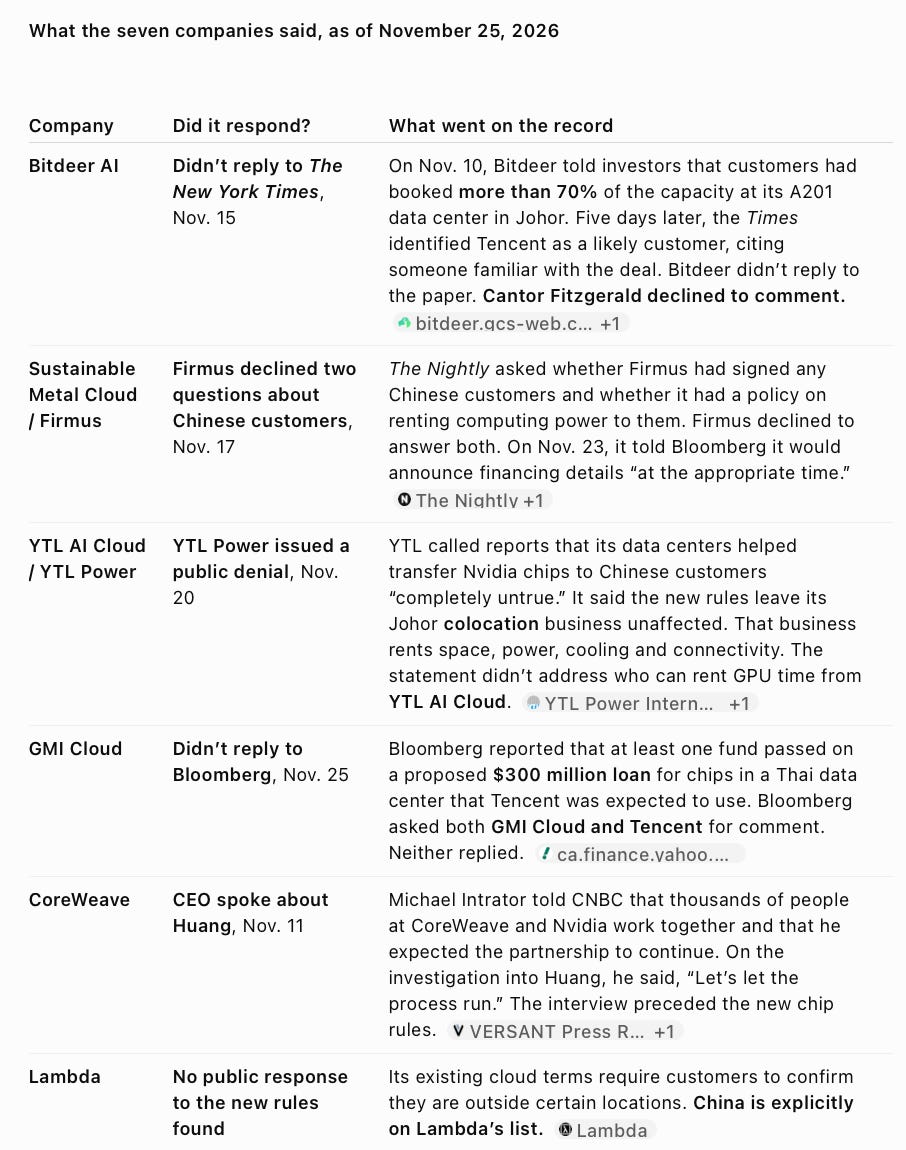
To leave you with the responses from my previous ChatGPT list of companies like Megaspeed, below are their on-the-record comments, or the lack thereof. Food for thought and topic for Thanksgiving dinner!